
Some paintings earn a permanent place on any list of famous Indian paintings because a king commissioned them. Others earn it because a nation adopted them as a symbol, or because a single auction night sent the price into the millions. A few earn that label simply by outlasting everyone who watched them get made, surviving on a cave wall for close to two thousand years while entire empires rose and disappeared around them. If you’ve ever wondered which famous Indian paintings actually earn that reputation and why, this guide takes you through them one by one. Along the way you’ll meet a bodhisattva painted deep inside a rock cut cave, a court poet reimagined as a goddess, a mother and a nation folded into a single canvas, and the artists who turned mythology, protest and raw color into some of the most famous and highest priced Indian paintings the country has ever produced. We start with a cave wall in Maharashtra and end with a sale that happened only a few months ago, proof that this history of famous Indian paintings is still very much being written.
Why These Paintings Still Matter
A painting earns a place on this kind of list for one of a few reasons, and rarely just one. It might be old enough to count as a historical record, the kind of work that survived when almost nothing else from its era did. It might be painted by someone whose choices changed the direction Indian art took afterward, the way a single artist’s decision to paint mythology like a photograph, or folk art like folk art again, reshaped what came next for everyone who followed. Some paintings earn their place because they got swept up in a moment bigger than themselves, a freedom movement, a religious revival, a royal court’s rise or fall, and ended up carrying that moment’s weight long after the moment itself had passed. A few are famous today for the plainest reason there is, someone paid an enormous amount of money for them, and the number itself became the story people now tell. Several of the paintings below check more than one of these boxes at once, which is usually a good sign that a painting was never just decoration to begin with.
-
Padmapani Inside The Ajanta Caves
Long before anyone signed a canvas in India, painters were working directly onto cave walls with mineral pigment and lime plaster. The Ajanta Caves in Maharashtra hold the best surviving examples, painted mostly between the 2nd century BCE and the 6th century CE to illustrate the Jataka tales, stories from the Buddha’s earlier lives.
The most recognized image from the site is Padmapani, a bodhisattva painted inside Cave 1 holding a blue lotus, his eyes lowered in quiet concentration. Art historians consistently point to this figure as one of the most emotionally rich paintings to survive from the ancient world, and it remains the reference point for almost every discussion of early Indian art.
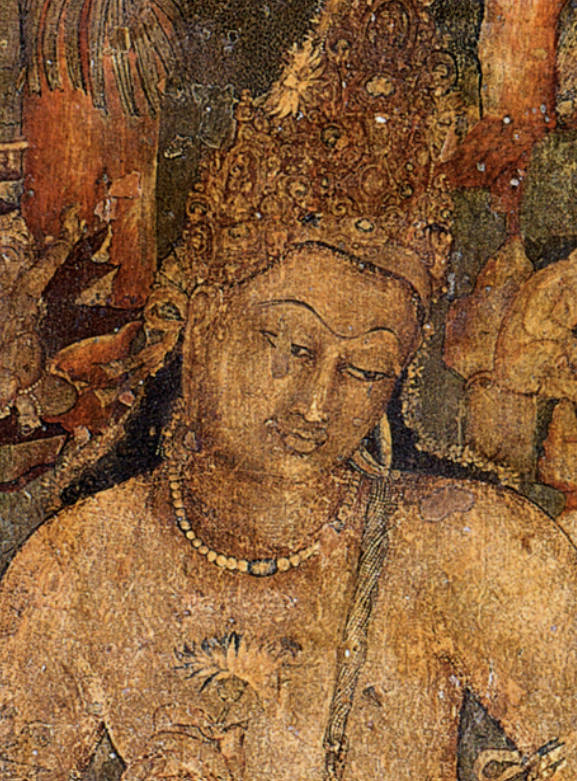 Padmapani, the bodhisattva mural inside Ajanta Cave 1, among the oldest surviving paintings in India. Public domain image via Wikimedia Commons.
-
Bani Thani India’s Mona Lisa
Move forward more than a thousand years to Rajasthan and the story changes completely. Around 1750, the painter Nihal Chand created a portrait for Raja Sawant Singh of Kishangarh, showing the ruler and a court poet and singer named Bani Thani reimagined as Radha and Krishna.
The painting became the defining image of the Kishangarh school, known for arched eyebrows, long lotus shaped eyes and a sharply pointed chin. Its striking, almost otherworldly beauty is why art writers started calling it India’s Mona Lisa, a nickname that stuck well enough to land the portrait on an Indian postage stamp in 1973. The original is kept at the National Museum in New Delhi.
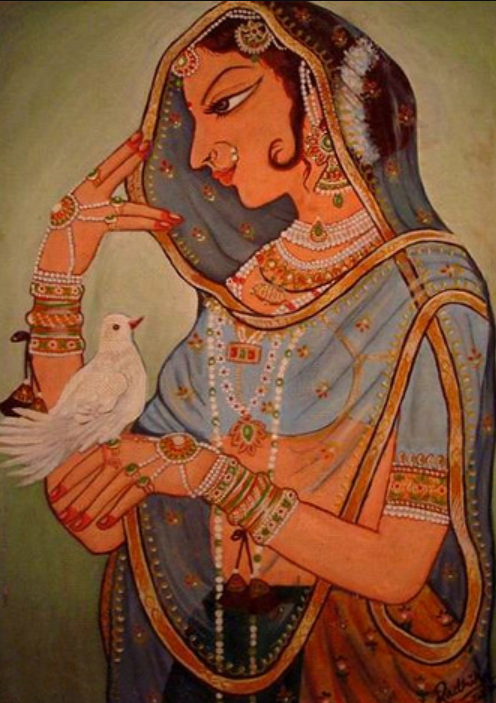 Bani Thani, the 1750 Kishangarh school portrait now called India’s Mona Lisa. Public domain image via Wikimedia Commons.
-
Bharat Mata And Indian Freedom
Not every famous Indian painting is about beauty or devotion. Some were made to shift how people saw their own country. In 1905, during the unrest that followed the Partition of Bengal, Abanindranath Tagore painted a saffron robed woman holding a book, sheaves of rice, cloth and a rosary in her four hands.
Tagore called it Banga Mata, meant as Mother Bengal. Sister Nivedita renamed it Bharat Mata and encouraged its wide circulation, and the painting grew into a symbol used across the independence movement. It now hangs at Victoria Memorial Hall in Kolkata, and the image still shapes how India visualizes itself as a nation more than a century later.
-
Raja Ravi Varma And Shakuntala
Raja Ravi Varma, active from 1848 to 1906, gave Indian mythology a face that ordinary households could actually own. Trained in a European realist style, he painted scenes from the Ramayana and Mahabharata and then ran them through his own lithographic press as affordable prints. Shakuntala, showing the heroine of Kalidasa’s play pretending to remove a thorn while glancing back at her lover, became one of the most reproduced images in Indian visual culture.
His painting Yashoda and Krishna, showing the infant god reaching for his foster mother as she milks a cow, sold at a Saffronart auction in April 2026 for close to eighteen million dollars, reported in Indian outlets at roughly one hundred sixty seven crore rupees. Business daily Cyrus Poonawalla was named as the buyer. The sale made Yashoda and Krishna the most expensive Indian painting ever sold at auction, overtaking M.F. Husain’s Gram Yatra, which had held the record for barely a year.
-
Amrita Sher-Gil Paints Honest Portraits
Amrita Sher-Gil was born in Budapest in 1913 to a Hungarian mother and a Punjabi Sikh father, trained in Paris, then came back to India determined to paint people as they actually were. Her 1935 painting Group of Three Girls and her 1937 Bride’s Toilet look closely at the quiet, often hard inner lives of Indian women, painted with a directness Indian art hadn’t really shown before.
She died at 28, but her impact was large enough that the government of India declared her entire body of work a national art treasure, and most of it now lives at the National Gallery of Modern Art in Delhi. Her 1937 painting The Story Teller sold in 2023 for 7.4 million dollars, a record at the time and still one of the highest prices ever paid for an Indian painting.
-
Husain’s Horses And Record Sale
M.F. Husain started out painting Bollywood film billboards to support himself after his father’s death cut his formal training short. In 1947 he co-founded the Progressive Artists Group alongside F.N. Souza and S.H. Raza, a movement that pushed Indian art toward modernism without dropping Indian subject matter.
Husain became best known for his horses, painted in fast, confident strokes that turned a single animal into a personal signature repeated across decades of work. In March 2025, his painting Gram Yatra sold at Christie’s in New York for about 13.8 million dollars, briefly making it the most expensive Indian painting ever sold, a record that Raja Ravi Varma’s Yashoda and Krishna would beat about a year later.
-
Raza And Gaitonde Redefine Abstraction
S.H. Raza, the third founder of the Progressive Artists Group, spent much of his career developing the Bindu, a circular form drawn from Indian philosophy representing a single point of origin. His 1983 painting Saurashtra, an abstract composition built from bands of color, sold in 2010 for about 3.49 million dollars, a record for his work at the time.
V.S. Gaitonde worked in a different register entirely, layering color into abstract compositions with almost no figurative reference at all. His paintings now regularly set the pace for Indian abstract art at auction, and an untitled 1970 canvas sold at Saffronart in September 2025 for roughly 7.6 million dollars, or about sixty seven crore rupees, making it one of the highest prices ever paid for a work by an Indian modernist.
-
Tyeb Mehta’s Bull And Celebration
Tyeb Mehta belonged to the generation that followed Husain, Raza and Souza, and his paintings are built around a signature diagonal line that splits the canvas and the figures on it. His 1956 painting Trussed Bull, showing an animal bound and helpless, sold at a Saffronart auction for about 61.8 crore rupees, close to 7.3 million dollars, briefly ranking among the highest prices paid for an Indian painting. His other major works, Celebration and Kali, are held up alongside it as the clearest examples of his style.
Ranking These Paintings By Price
| Painting | Artist | Approximate Price | Year Sold |
| Yashoda and Krishna | Raja Ravi Varma | 17.9 million dollars | 2026 |
| Gram Yatra | M.F. Husain | 13.8 million dollars | 2025 |
| Untitled (1970) | V.S. Gaitonde | 7.6 million dollars | 2025 |
| The Story Teller | Amrita Sher-Gil | 7.4 million dollars | 2023 |
| Trussed Bull | Tyeb Mehta | 7.3 million dollars | 2025 |
Prices are auction hammer figures converted to approximate dollar values and can shift slightly depending on the exchange rate used on the day of sale. What the table makes clear either way is how much movement there has been in just the last two years, with the record changing hands three times between 2023 and 2026.
Folk Art Beyond This List
Everything above is a single named painting by a single named artist, but a huge amount of Indian art history was never signed at all. Regional and tribal traditions such as Madhubani, Gond and Pichwai painting are still practiced by hand today, each with its own symbolism and technique built up over generations rather than tied to one artist or one canvas. We’ve covered each of these in full in our own guides, including our Madhubani painting guide, our Gond art painting guide and our Pichwai painting guide, if you want to go deeper into any one of them.
At The Brushstrokes Co, this is the part of Indian art we work with most closely, sourcing original folk and contemporary pieces directly from the artists who still paint them by hand today.
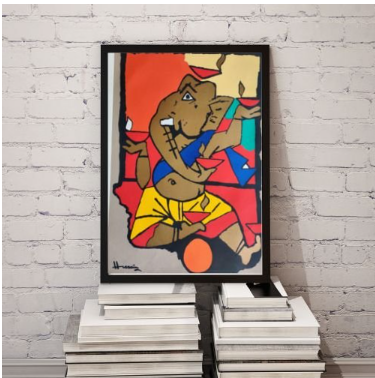 An example of the handmade detail and natural pigment worth looking for in an original Indian folk painting, from The Brushstrokes Co collection.
How To Start Your Collection
None of this history has to stay behind museum glass. If one of these artists or styles caught your attention, buying a piece for your own home is more approachable than the auction prices above might suggest, since original folk and contemporary work is priced well below what a Sher-Gil or a Husain fetches at auction.
Start with the style that actually pulled you in rather than trying to represent every era at once. Ask who painted the piece and where they trained. A seller who answers that clearly and quickly is almost always working with genuine handmade art. Our original paintings collection is organized by artist and style for exactly this kind of browsing, our Indian Artists directory is worth checking before you commit to a specific painter, and our M.F. Husain paintings and S.H. Raza paintings pages carry authorized prints if an original from either artist is out of reach.
Expert tip. Natural light shows off hand mixed pigment far better than a harsh overhead bulb, so think about where a piece will actually hang before you settle on a size or a frame.
Mistakes First Time Buyers Make
Assuming a printed reproduction is a hand painted original is the single most expensive mistake a new buyer makes, since a good print photographs just as well as the real thing until you’re standing in front of it.
Skipping questions about the artist or the piece’s background is a close second. A genuine seller can name the artist, their region and their working style without hesitation.
Choosing a size before checking the room’s light and existing colors often ends with a painting that gets moved into storage within a year.
Treating every Indian painting as interchangeable is the last common trap. A Gond piece and a Thanjavur piece serve completely different purposes on a wall, and knowing that difference is what keeps you happy with a purchase a decade later, not just this season.
Frequently Asked Questions
What is the most famous Indian painting today?
Raja Ravi Varma’s Yashoda and Krishna is currently considered the most famous Indian painting in terms of auction value after achieving a record sale in 2026. From a historical and cultural perspective, however, paintings such as Bharat Mata by Abanindranath Tagore and the Ajanta Cave murals continue to be among India’s most celebrated artistic masterpieces because of their lasting influence on Indian art and heritage.
Which Indian painting sold for the highest price?
Yashoda and Krishna by Raja Ravi Varma currently holds the record for the highest price paid for an Indian painting at auction. Its landmark sale surpassed previous record holders, including Gram Yatra by M.F. Husain and an untitled 1970 masterpiece by V.S. Gaitonde, highlighting the growing global appreciation for Indian art.
What is the oldest famous Indian painting?
One of the oldest surviving Indian paintings is Padmapani, found inside Cave 1 of the Ajanta Caves. Created between the 2nd century BCE and the 6th century CE, this remarkable mural is admired for its graceful composition, delicate expressions, and exceptional preservation, making it a landmark in the history of Indian painting.
Why is Bani Thani called India’s Mona Lisa?
Bani Thani is often referred to as India’s Mona Lisa because of the subject’s graceful features, mysterious smile, and timeless elegance. Painted in the Kishangarh style, it has become one of the most recognizable portraits in Indian art, earning comparisons to Leonardo da Vinci’s famous masterpiece.
Who is called the father of modern Indian art?
Raja Ravi Varma is widely regarded as the father of modern Indian art. He blended European academic realism with Indian mythology and culture, creating paintings that appealed to both royalty and ordinary people. Through affordable printed reproductions, his artworks reached homes across India and transformed the country’s visual culture.
Which painting became a symbol of India’s freedom movement?
Bharat Mata, painted by Abanindranath Tagore in 1905, became one of the strongest artistic symbols of India’s freedom movement. The painting depicts the nation as a serene and spiritual mother figure, inspiring patriotism and becoming closely associated with the struggle for independence.
What is the difference between classical and folk Indian painting?
Classical Indian paintings were typically created by professionally trained artists working under royal courts or wealthy patrons, with a strong focus on refined techniques and formal artistic traditions. Folk painting traditions such as Madhubani, Gond, and Pichwai, on the other hand, developed within local communities and were passed down through generations as part of everyday cultural and religious practices.
Can I buy prints of these famous paintings today?
Yes. Authorized prints of works by renowned artists such as M.F. Husain and S.H. Raza are available through reputable galleries and licensed sellers. At the same time, original hand-painted artworks in traditional styles like Madhubani, Gond, and Pichwai continue to be created by skilled artists, making it possible to own authentic pieces that celebrate India’s rich artistic heritage.