
A Madhubani painting does something very few art forms can. It captures your attention within seconds, yet the more you look at it, the more details begin to reveal themselves. Every inch of the surface has a purpose, from the intricate patterns and bold natural colors to the birds, flowers, fish, and deities that quietly carry stories passed down through generations. It is one of those rare traditions that feels just as relevant on a modern living room wall as it did on the mud walls of villages in Bihar centuries ago.
The lasting appeal of Madhubani painting goes far beyond its striking appearance. Each artwork reflects a way of life, a celebration of nature, faith, family, and cultural memory that has survived because artists continued to preserve and evolve the tradition without losing its identity. That balance between heritage and creativity is what keeps people across India and around the world drawn to this remarkable folk art.
This guide explores why Madhubani painting continues to captivate art lovers, where it began, the stories behind its symbols and styles, how to identify an authentic hand-painted piece, and why it remains one of the most meaningful choices for home décor, gifting, and collecting today.
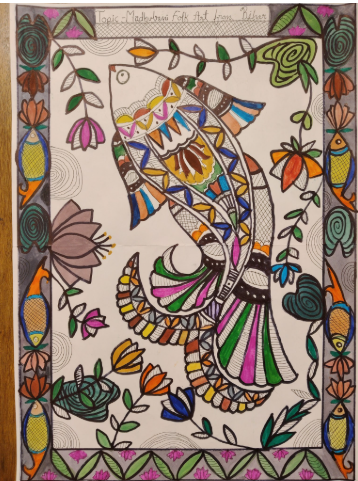
A traditional Madhubani composition built around fish and floral motifs, both common symbols of fertility and good fortune. Photo by Pavitra Maheshwari, Pexels.
What Is Madhubani Painting Really
Madhubani painting is a folk art tradition from the Mithila region, which spans parts of Bihar in India and the Terai plains of Nepal. It gets its more common name from Madhubani district, one of the region’s key artistic centers, though local practitioners often call it Mithila painting instead.
At its core, the art form is about filling space. Lines are fine and deliberate, colors are bold and flat rather than shaded, and almost no part of the surface is left empty. Borders are packed with smaller motifs, flowers, fish, birds, geometric patterns, framing the central figures like a decorated doorway.
What separates it from decoration for its own sake is intention. Every element traditionally carried meaning tied to fertility, prosperity, protection, or a specific deity. A painting was not just hung to look nice. It was made for a wedding, a festival, or a prayer, and its symbols were doing quiet work in the background.
Where This Art Form Began
Local legend traces Madhubani painting back to King Janak of Mithila, who is said to have commissioned artists to paint the walls of his kingdom to celebrate his daughter Sita’s marriage to Prince Rama. Whether or not that exact origin holds up historically, it tells you something important, that this art form has always been tied to marriage, celebration, and sacred storytelling.
For centuries, the practice stayed almost entirely inside the home. Women of the Mithila region painted directly onto the mud walls of their houses, particularly the kohbar ghar, the nuptial chamber prepared for a new bride, decorating it with fertility symbols, lotus ponds, and depictions of the couple’s union. It was a domestic ritual passed from mother to daughter, never sold, never signed, never meant to leave the village.
That domestic, almost invisible existence is exactly why the wider world did not discover Madhubani painting until the twentieth century, and even then, it took a natural disaster to bring it into view.
The Earthquake That Saved An Art
In 1934, an earthquake measuring roughly 8.0 in magnitude tore through Nepal and northern Bihar, flattening entire villages. William Archer, a British magistrate posted in Madhubani barely a year earlier, was inspecting the damage when he stepped into a home whose mud wall had cracked open, revealing an elaborate kohbar mural underneath, a discovery he later wrote about at length.
Archer later wrote that he forgot the earthquake entirely for almost an hour, standing in front of the painting. He photographed what he found and eventually published a paper on Mithila art in 1949, though it drew little attention outside a small circle of researchers at the time.
The real turning point came decades later. In the mid 1960s, a severe drought hit Bihar, and the All India Handicrafts Board looked for ways to create income for affected families. Pupul Jayakar, who led the initiative, brought in Mumbai based artist Bhaskar Kulkarni to encourage women in villages like Jitwarpur and Ranti to transfer their wall art onto handmade paper for the first time. What had lived only on mud walls for generations suddenly had a way to travel.
How Villages Turned Walls Into Paper
The shift from wall to paper changed everything about how this art form survived. A wall painting disappeared the moment a house was rebuilt or repainted. A paper painting could be rolled up, carried to a city, sold, and framed on someone else’s wall a thousand kilometers away.
The first paper based Madhubani paintings were shown at an exhibition in Delhi in 1967. Within a few years, the work had traveled to exhibitions in Japan, Europe, the erstwhile Soviet Union, and the United States, introducing an art form that had existed almost entirely within a few districts of Bihar to an international audience for the first time.
Jitwarpur and Ranti remain closely associated with the craft today, home to generations of families who still paint using techniques barely changed from what their grandmothers practiced, just with a wider audience now able to actually see and own the work.
Five Distinct Styles Worth Knowing
Not all Madhubani painting looks the same, and knowing the differences helps explain why two pieces can look so different while both being authentic to the tradition.
Bharni is the fullest, most colorful style, historically practiced by upper caste communities, filled almost entirely with saturated color and religious imagery. Kachni relies on fine, restrained line work with much less color, letting the intricacy of the linework itself carry the piece. Tantrik style draws on esoteric and symbolic imagery, often centered on powerful goddess forms and geometric patterns tied to ritual practice.
Godna style has different roots entirely, emerging from Dalit communities and drawing its visual language from traditional tattoo patterns rather than the wall painting tradition. Kohbar style is the one tied most directly to weddings, built around lotus ponds, bamboo groves, and fertility symbols traditionally painted for the nuptial chamber.
Similar regional folk traditions took shape elsewhere in India too. If you want to see how a very different community expressed a similar instinct for pattern and storytelling, our piece on Gond art paintings covers the tribal painting tradition of central India, which shares Madhubani’s density of detail but comes from an entirely different cultural root.
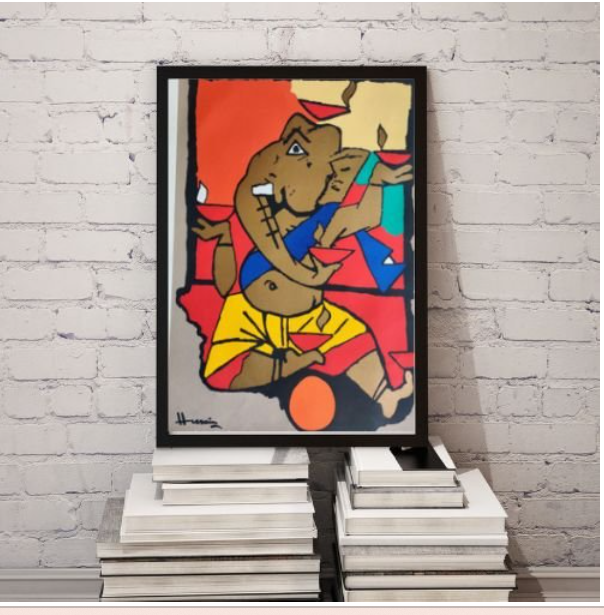 An example of the hand-painted, original Indian artwork in The Brushstrokes Co collection, the same level of handmade detail collectors look for in an authentic Madhubani piece.
Colors That Come From Nature
Traditional Madhubani painting never touched a tube of synthetic paint. Every color came from something growing nearby, ground down, mixed with a binder, and applied with a twig, a matchstick, or a fine brush made from bamboo.
Red came from vermilion mixed with mustard seed. Yellow came from turmeric or the pollen of certain flowers. Blue was extracted from indigo, orange from the palash flower, and green from bilva leaves. White, used constantly for backgrounds and outlines, came from rice paste. A greenish black used for outlines and fine detail was made by mixing cow dung with lampblack, and gum arabic or goat’s milk was often used to bind the pigment so it held to the surface.
Many contemporary artists now work with more accessible acrylic paints for durability and vibrancy, especially on canvas pieces meant for framing, but the color palette still leans heavily on the same earthy, natural tones that defined the original wall paintings. That continuity is part of what makes an authentic Madhubani piece recognizable even before you look closely at the linework.
Symbols Hidden In Every Painting
Look closely at a Madhubani painting and you will notice it rarely tells a random scene. Fish represent fertility and good fortune. Peacocks and parrots signal love and companionship, often appearing in pairs near a central figure. The sun and moon appear together frequently, representing balance and the passage of time. Lotus flowers, especially in Kohbar compositions, stand for purity and new beginnings.
Human and divine figures carry weight too. Krishna, Rama and Sita, and goddess forms like Durga or Kali appear often, usually stylized rather than realistic, with large eyes and minimal facial detail. Trees, particularly the tree of life motif, tie the whole composition together, representing continuity between generations.
None of this is decorative filler. In a tradition where every inch of space carries meaning, learning to read a few of these symbols changes how a painting feels on your wall. It stops being an abstract pattern and starts being a message, the same one a family might have painted for a wedding two centuries ago.
Why Women Carried This Tradition
Madhubani painting survived for centuries specifically because it was never treated as a professional art form. It was a domestic skill, taught to girls in the Mithila region as part of growing up, alongside cooking and household management, and practiced collectively during festivals and family celebrations.
That female led lineage is part of why the tradition carries such intimate, personal symbolism, since it was made by women for their own homes and rituals rather than for outside buyers or patrons. Even after the shift to paper and commercial sale, women remain the primary practitioners and torchbearers of the craft, and most of the recognized master artists in Madhubani painting today are women who learned directly from their mothers and grandmothers.
This is worth remembering when you buy an original piece. You are not just acquiring a painting. You are supporting a craft economy that still runs largely through women artists in rural Bihar, many of whom rely on this work as a primary source of household income.
Artists Who Took It Global
A handful of artists turned Madhubani painting from a regional craft into a nationally and internationally recognized art form. Sita Devi, honored with a Padma Shri in 1981, became one of the first Madhubani artists to gain widespread recognition outside Bihar, known for her bold Bharni style compositions.
Ganga Devi, awarded a Padma Shri in 1984, pushed the tradition further, using her painting to document everything from village life to her own experience with cancer, proving the form could carry personal narrative as well as ritual symbolism. Jagdamba Devi, recognized as early as 1975, is often credited as one of the artists whose early work helped convince the government that this craft deserved serious cultural support.
More recent artists like Baua Devi and Dulari Devi have continued the tradition into the present day, and the craft’s cultural significance was formally recognized when Madhubani painting received Geographical Indication status in 2007, legally protecting it as a product uniquely tied to the Mithila region of Bihar. Smarthistory’s overview of painting in Mithila is a useful academic resource if you want to see original works by Sita Devi and Ganga Devi alongside deeper historical context.
Spotting An Authentic Madhubani Piece
As Madhubani painting has grown in popularity, mass produced prints and digitally reproduced versions have flooded the market, often sold at a fraction of what a genuine hand-painted piece costs. Knowing the difference matters if you actually want the real thing.
An authentic piece will show small, human irregularities up close. Line thickness varies slightly, colors are never perfectly uniform, and you can often see the texture of the brush or twig used to apply the paint. A printed reproduction, by contrast, tends to look mechanically consistent, with flat, evenly distributed color and no visible texture at all.
It also helps to ask directly where a piece comes from and who painted it. A seller who can tell you the artist’s name, their village, and something about their style is almost always working with genuine handmade work rather than reproductions. Our collection of original paintings gives you a sense of what to expect from verified, hand-painted Indian art, including the kind of provenance detail worth asking for regardless of where you buy.
Where Madhubani Fits In Homes
A common hesitation with traditional folk art is wondering whether it fits a modern home. In practice, Madhubani painting tends to work better in contemporary interiors than people expect, precisely because its flat colors and clean linework read as graphic rather than dated.
A single, well framed Madhubani piece works as a striking focal point in a living room, especially against a plain wall where its detail has room to stand out. Smaller pieces suit a reading corner, hallway, or home office, adding warmth without overwhelming the space. Pairing one with otherwise minimal, neutral decor tends to work particularly well, letting the painting’s density of detail become the room’s main visual interest rather than competing with other patterns.
Placement matters almost as much as the piece itself. Natural or warm artificial light brings out the depth of the natural pigments far better than harsh overhead lighting, and giving the painting some breathing room on the wall, rather than crowding it with other frames, lets its intricacy actually register from across the room.
Choosing Madhubani As A Gift
Traditional art carries a kind of weight that most generic gifts do not. A Madhubani painting works particularly well for occasions tied to celebration and new beginnings, weddings, housewarmings, anniversaries, since the art form’s own history is so closely tied to exactly those moments.
For a wedding gift, a Kohbar style piece carries extra meaning, given its direct historical connection to marriage rituals in the Mithila tradition. For a housewarming, a piece centered on the tree of life or a pair of birds works well, symbolically wishing continuity and companionship in a new home. Corporate gifting has also increasingly leaned toward authentic Indian folk art like Madhubani painting, since it signals cultural appreciation in a way a generic hamper never could.
If gifting is what brought you here, our gifting collection is built specifically around this kind of occasion led buying, with pieces sized and framed for giving rather than just displaying, including traditional folk art alongside more contemporary Indian pieces.
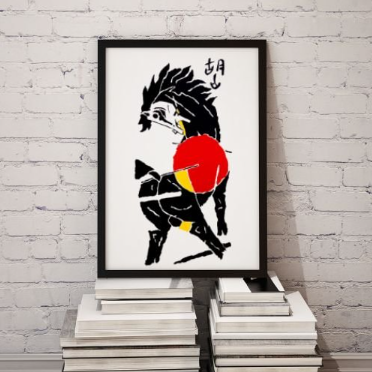 A framed original piece from The Brushstrokes Co collection, styled the way a gifted painting typically arrives, ready to hang rather than needing to be framed after purchase.
Caring For Your Madhubani Painting
Because many original Madhubani paintings are made with natural pigments and handmade paper, they need a bit more care than a standard printed poster, though nothing complicated.
Direct sunlight is the biggest risk, since UV exposure gradually fades natural dyes faster than synthetic ones. Hanging your piece away from a window that gets harsh afternoon light, or behind UV protective glass if it is framed, preserves the color noticeably longer. Humidity is the second concern, particularly for paper based pieces, so avoiding bathrooms, kitchens, or other damp areas keeps the paper from warping or developing mold over time.
For cleaning, a soft, dry brush or a gentle puff of air is far safer than any liquid cleaner, which can smear natural pigments almost instantly. If a piece is genuinely valuable to you, professional conservation framing with acid free mats and UV glass is worth the investment, since it protects decades of a family’s craft tradition rather than just the piece hanging in front of you.
Bringing This Heritage Into Your Home
Madhubani painting has survived an earthquake, a drought, generations of quiet domestic practice, and a complete shift from mud walls to gallery walls, and it did all of that without losing the density, symbolism, and natural material palette that made it distinctive in the first place. That is a rare thing for any art form to pull off.
Understanding the styles, the symbolism, and what genuine handmade work actually looks like changes how you shop for it too. A Madhubani painting stops being just a colorful wall piece and becomes something closer to what it always was, a small, deliberate act of storytelling passed down through generations of women in one region of Bihar.
At Brushstrokes Co, we care about that context as much as the finished piece, since a painting is worth more once you understand what is actually happening inside it. If you are ready to bring an original piece of Indian folk art into your home, our original paintings collection is a good place to start browsing, and our gifting collection is worth exploring if you are buying for someone else’s milestone rather than your own wall.
Frequently Asked Questions
What is Madhubani painting?
Madhubani painting is a traditional Indian folk art form that originated in the Mithila region of Bihar. It is known for its intricate line work, vibrant natural colors, and symbolic illustrations of nature, deities, festivals, and everyday life. Traditionally created by women on mud walls and floors, this centuries old art form is now widely painted on paper, canvas, and fabric while preserving its distinctive visual style.
Why is Madhubani painting famous?
Madhubani painting is celebrated for its rich cultural heritage, unique artistic style, and remarkable journey from rural homes to international galleries. The art gained wider recognition after the 1934 Bihar earthquake when British magistrate William G. Archer documented the wall paintings. Its revival in the 1960s helped create livelihoods for local artists, and in 2007 Madhubani painting received a Geographical Indication tag, further recognizing its cultural significance.
What materials are used in Madhubani painting?
Traditional Madhubani paintings are created using natural pigments made from ingredients such as turmeric, vermilion, indigo, rice paste, lampblack, and cow dung. Artists typically use bamboo twigs, cotton wrapped sticks, or fine brushes to apply the colors, which are often mixed with natural binders like gum arabic or goat’s milk. Today, many contemporary artists also use acrylic paints and canvas while maintaining the traditional techniques.
How can I tell if a Madhubani painting is authentic?
An authentic Madhubani painting usually displays slight variations in line thickness, hand drawn details, and visible brush or twig textures. These natural imperfections are a sign of handcrafted work. In contrast, printed reproductions often appear mechanically perfect, with uniform colors, identical patterns, and a flat surface that lacks the texture of an original artwork.
What do the colors in Madhubani painting mean?
The colors used in Madhubani painting are traditionally derived from natural sources and often hold symbolic meanings. Red represents auspiciousness and celebration, yellow signifies prosperity and knowledge, green symbolizes nature and growth, while black is used to define outlines and create contrast. Together, these colors reflect the traditions, beliefs, and environment of the Mithila region.
Is Madhubani painting only made in Bihar?
Madhubani painting originated in the Mithila region, which extends across northern Bihar in India and parts of the Terai region in Nepal. Although artists in other regions now practice the style, the Madhubani district of Bihar remains the most recognized and culturally significant center for authentic Madhubani paintings.
How much does an original Madhubani painting cost?
The price of an original Madhubani painting depends on factors such as its size, level of detail, materials, and the reputation of the artist. Smaller works on handmade paper are generally more affordable, while large canvas paintings created by renowned artists can command significantly higher prices. Understanding the artist’s background and the materials used can help determine the artwork’s value.
Can Madhubani paintings be used for modern home decor?
Yes, Madhubani paintings blend beautifully with modern interiors. Their bold patterns, vibrant colors, and intricate detailing create striking focal points in contemporary homes. Whether displayed in living rooms, bedrooms, offices, or entryways, they add cultural depth and artistic character without feeling outdated.
What is the difference between Madhubani and Warli painting?
Although both are traditional Indian folk art forms, Madhubani and Warli paintings have distinct origins and styles. Madhubani painting comes from the Mithila region of Bihar and features colorful, densely filled compositions with mythological and natural themes. Warli painting originates from the tribal communities of Maharashtra and is characterized by simple white geometric figures painted on earthy backgrounds, giving it a more minimalistic appearance.
Who are some famous Madhubani artists?
Several artists have played an important role in bringing Madhubani painting to national and international audiences. Padma Shri awardees Jagdamba Devi, Sita Devi, and Ganga Devi are among the pioneers of the art form. Contemporary artists such as Baua Devi and Dulari Devi have also received widespread recognition for preserving and promoting this traditional style through their exceptional work.
Is a Madhubani painting a good gift?
A hand painted Madhubani artwork makes a thoughtful and meaningful gift for occasions such as weddings, anniversaries, housewarmings, and festivals. Since the art form has deep cultural connections with celebration, prosperity, and marriage, gifting an original Madhubani painting offers lasting artistic and emotional value that goes beyond ordinary decorative items.
How do you care for a Madhubani painting?
To preserve a Madhubani painting, keep it away from direct sunlight, excessive humidity, and moisture, as these can damage natural pigments and paper. Dust the artwork gently with a soft dry brush or use light airflow instead of wet cleaning methods. For long term protection, frame the painting using acid free materials and UV protective glass to help maintain its colors and condition for years.