
Maqbool Fida Husain, better known as M.F. Husain, was one of India’s most prominent modern artists.
His journey into art was unconventional.
After moving to Bombay, Husain worked painting large cinema hoardings and also designed furniture and toys. Working on enormous film posters helped him develop confidence with scale, simplified figures, dramatic compositions and strong visual storytelling.
These qualities later became important characteristics of his paintings.
Over time, Husain moved from commercial visual work into fine art and became increasingly involved in India’s emerging modern art movement.
His subjects remained strongly connected to India, but his visual style was modern, experimental and highly personal.
M.F. Husain and the Progressive Artists’ Group
An important moment in Husain’s development came through his association with the Progressive Artists’ Group in Bombay.
The group emerged around the time of Indian independence and played a major role in changing the direction of modern Indian art.
Artists associated with the movement wanted to move beyond rigid academic traditions and develop an artistic language that could reflect contemporary India while engaging with international modernism.
Husain became one of the most recognised artists associated with this new direction.
Instead of abandoning Indian culture, he repeatedly returned to mythology, village life, history, religion and popular culture.
What changed was the way he represented them.
What Made M.F. Husain’s Painting Style Unique?
M.F. Husain’s paintings are often recognisable even before the viewer sees his signature.
His artistic language relied on movement, simplified forms, confident lines and strong colour.
Bold Lines
Husain frequently used sweeping black lines to define figures, animals and objects.
Instead of carefully modelling every detail, he allowed the line itself to communicate movement and emotion.
Simplified Figures
Human bodies and faces in his work were often simplified or fragmented.
This moved the painting away from strict realism and allowed Husain to focus more heavily on emotion, symbolism and narrative.
Strong Colours
Red, yellow, blue, black and earthy colours frequently appear throughout Husain’s paintings.
His use of colour was rarely decorative alone.
Colour often helped communicate mood, intensity and movement.
Movement
Husain’s paintings rarely feel completely still.
Horses rear forward, figures twist, musicians perform and groups of people appear caught in moments of activity.
This strong sense of movement became one of the defining characteristics of his work.
Indian Themes Through Modern Art
Perhaps the most important feature of Husain’s style was the way he combined modernist techniques with subjects rooted in Indian life.
Mythology, village traditions, cinema, motherhood and cultural identity could all appear in the same artistic universe.
This helped his paintings feel both distinctly Indian and unmistakably modern.
Famous Paintings and Artworks by M.F. Husain
M.F. Husain is difficult to define through a single famous painting.
Unlike artists who become associated with one masterpiece, Husain is remembered through recurring subjects and major bodies of work developed across decades.
Several themes became particularly important.
M.F. Husain Horse Paintings
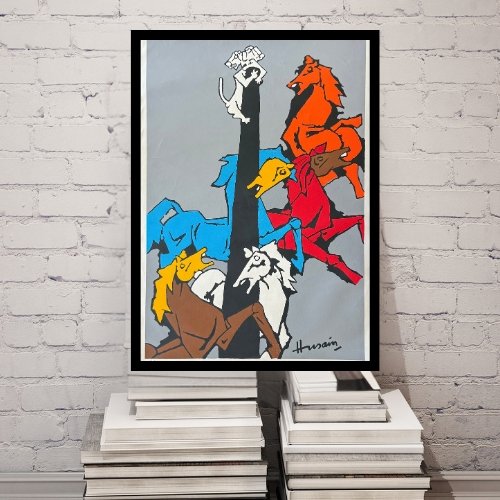
Horses are arguably the most recognisable subject in Husain’s art.
His horses are rarely calm or decorative.
They often appear to charge across the canvas with stretched bodies, powerful legs and sweeping lines.
The horse gave Husain an ideal subject through which to explore energy, speed and movement.
Rather than focusing on anatomical realism, he emphasised rhythm and emotion.
Over time, these paintings became so closely associated with Husain that the horse effectively became one of his artistic signatures.
Collectors and art enthusiasts continue to regard M.F. Husain horse paintings as some of the most characteristic works from his career.
Mother Teresa Series
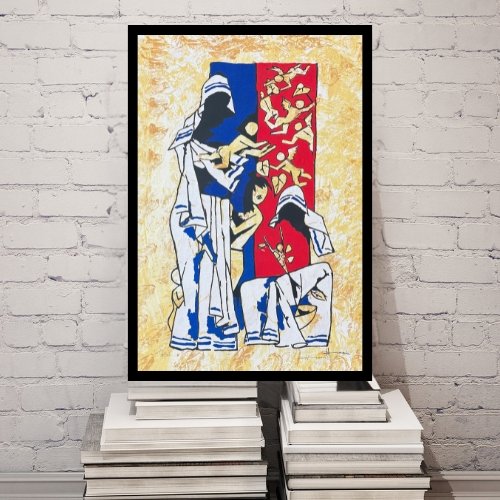
The Mother Teresa series reveals a very different side of Husain’s work.
Instead of relying on detailed portraiture, Husain often represented Mother Teresa through her clothing, posture and gestures.
The familiar white sari with blue borders became a symbolic visual element.
The paintings explored compassion, motherhood, protection and human suffering.
By avoiding conventional portrait likeness, Husain shifted attention away from the individual face and toward emotional meaning.
This series remains one of the strongest examples of his ability to simplify imagery while preserving emotional depth.
Mahabharata Paintings
Indian mythology was a major source of inspiration for M.F. Husain.
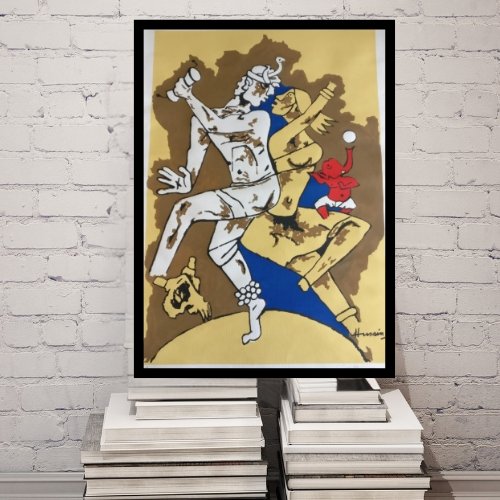
His paintings based on the Mahabharata transformed ancient narratives into modern compositions.
Rather than recreating traditional devotional imagery, he used fragmented figures, bold colour and dramatic movement.
The Mahabharata allowed Husain to explore themes such as conflict, power, duty, morality and violence.
These subjects connected ancient Indian narratives with modern human experiences.
Ramayana Paintings
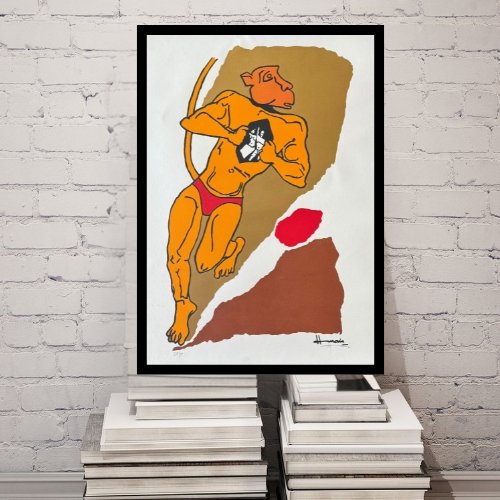
Husain also created works inspired by the Ramayana.
Again, his approach was not simply illustrative.
Characters and events from the epic were interpreted through his own visual vocabulary.
Simplified bodies, powerful gestures and expressive colours brought a contemporary quality to stories that had been depicted in Indian art for centuries.
These works demonstrate how Husain could respect cultural tradition while simultaneously reinventing it.
Rural India and Village Life
Village life played an important role in Husain’s understanding of India.
He painted rural figures, animals, labour, family life and everyday activities.
These subjects allowed him to explore Indian identity beyond mythology and elite culture.
One of the most significant examples of this interest is his monumental painting Untitled (Gram Yatra).
Untitled (Gram Yatra)
Untitled (Gram Yatra) is now regarded as one of the most important works associated with M.F. Husain.
Created in 1954, the painting stretches nearly 14 feet across and contains 13 interconnected scenes of Indian village life.
The work brings together human figures, animals and everyday rural activities into a large visual narrative.
It reflects Husain’s interest in Indian society while also demonstrating his engagement with modernism.
On March 19, 2025, Untitled (Gram Yatra) sold at Christie’s in New York for $13.75 million.
At the time of the auction, Christie’s described it as the largest sum ever paid for a work of Modern Indian Art and a new auction record for Husain.
Beyond its auction value, the work is important because it captures many of Husain’s central interests: Indian identity, rural life, movement, storytelling and modern artistic experimentation.
Why Were Horses Important in M.F. Husain’s Art?
Horses became one of the most enduring symbols in Husain’s work because they perfectly suited his visual language.
A horse offered speed, strength and dramatic movement.
Husain could reduce the animal into sweeping lines without losing its energy.
Instead of painting every physical detail, he concentrated on gesture.
This approach allowed the horse to become much more than an animal portrait.
Depending on the composition, it could communicate freedom, force, tension or vitality.
This is one reason M.F. Husain horse paintings remain among his most instantly recognisable works.
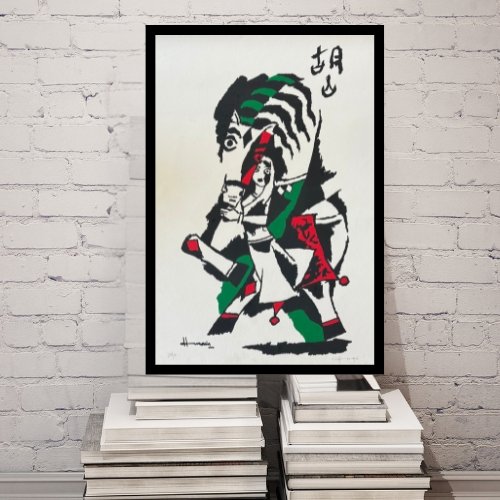
Women in M.F. Husain’s Paintings
Women appeared throughout Husain’s career in many different forms.
They were mothers, mythological figures, village women, symbols of India and characters inspired by popular culture.
His approach varied depending on the subject.
Some figures appear quiet and protective.
Others are powerful, monumental or symbolic.
Themes of motherhood were particularly important and can also be seen in works connected with Mother Teresa.
Through these recurring female figures, Husain explored ideas around identity, care, tradition and cultural symbolism.
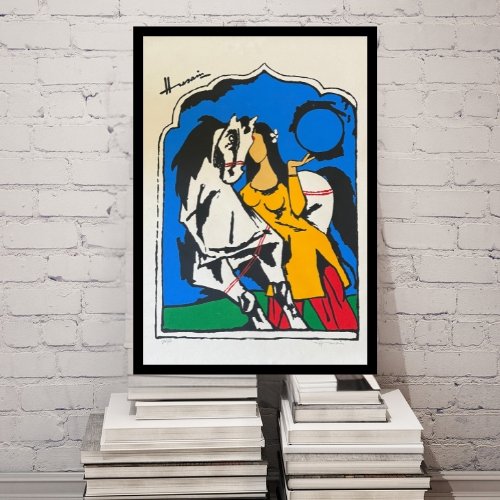
Cinema and Popular Culture
Husain’s relationship with cinema began long before he became a celebrated painter.
His early work creating film hoardings exposed him to large-scale imagery, dramatic poses and public storytelling.
Cinema continued to influence his artistic imagination.
Husain was also involved in filmmaking, showing that his interest in narrative extended beyond painting.
This relationship with film and popular culture helped distinguish him from many other modern artists.
His work could exist within serious art institutions while still maintaining a connection with India’s wider public culture.
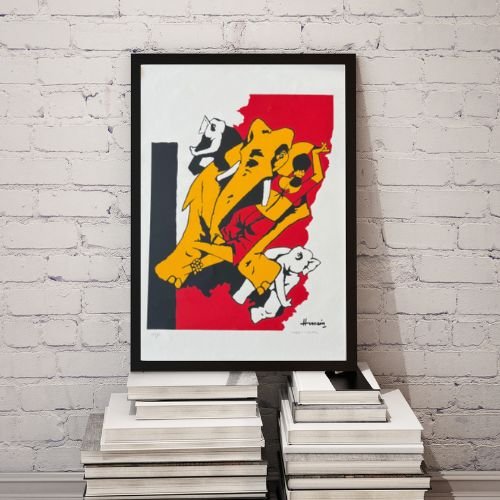
Indian Mythology in M.F. Husain’s Art
Husain returned repeatedly to Indian mythology throughout his career.
The Mahabharata and Ramayana gave him access to some of India’s most recognisable stories and characters.
However, he did not simply reproduce established religious imagery.
Instead, he used mythology as raw material for modern artistic interpretation.
Figures could be fragmented, simplified or placed in unexpected compositions.
Through this approach, ancient stories became vehicles for exploring modern ideas about power, conflict, identity, morality and spirituality.
Why Did M.F. Husain Leave India?
The later part of M.F. Husain’s life was marked by controversy.
Some of his representations of Hindu deities generated strong criticism and protests.
His supporters defended the works as artistic interpretation, while critics viewed some depictions as offensive.
Legal cases, protests and threats became part of the public debate surrounding his work.
Eventually, Husain spent much of his later life outside India.
This period remains one of the most debated chapters in his career and continues to raise broader questions about artistic freedom, religion, public reaction and cultural sensitivity.
Awards and Recognition
M.F. Husain received significant recognition during his career.
Among his major Indian civilian honours were:
- Padma Shri
- Padma Bhushan
- Padma Vibhushan
His work was exhibited internationally and became increasingly important within the global market for modern Indian art.
Today, auction results, museum interest and academic research continue to demonstrate his importance within South Asian modernism.
M.F. Husain’s Most Expensive Painting
One of the most significant auction moments in Husain’s career came with the sale of Untitled (Gram Yatra).
The work sold for $13.75 million at Christie’s in New York on March 19, 2025, dramatically surpassing Husain’s previous auction record.
The sale brought renewed international attention not only to Husain but also to the broader market for modern Indian art.
Auction values can change over time, so the importance of the painting should not be understood only through its price.
Its scale, date, subject and place within Husain’s artistic development make it historically important regardless of market value.
Why M.F. Husain Still Matters Today
Husain’s importance comes from more than fame or auction records.
He helped create a modern visual vocabulary that remained deeply connected to India.
His paintings demonstrated that modern Indian art did not need to choose between tradition and experimentation.
Both could exist together.
A mythological figure could be transformed through modernism.
A village scene could become part of an international conversation about contemporary art.
A horse could become an expression of energy rather than simply an animal study.
A familiar cultural symbol could take on entirely new meaning.
This ability to reinterpret India rather than simply illustrate it remains central to Husain’s legacy.
Collecting M.F. Husain Art
M.F. Husain’s work remains highly sought after within the modern Indian art market.
Collectors may encounter original paintings, drawings, serigraphs, prints and limited editions associated with the artist.
Before purchasing any significant artwork attributed to M.F. Husain, several factors should be considered.
Provenance
Provenance refers to the documented ownership history of an artwork.
Clear provenance can help establish the history and authenticity of a work.
Authenticity
A signature alone should never be treated as sufficient proof of authenticity.
Documentation, expert examination and reputable seller information are much more important.
Medium
Husain worked across different media.
The medium, surface and technique can affect both the historical significance and market value of a work.
Condition
Damage, restoration, fading or surface deterioration can affect an artwork’s appearance and value.
Edition Information
When purchasing prints or serigraphs, check whether the work belongs to a limited edition and whether the edition number is clearly documented.
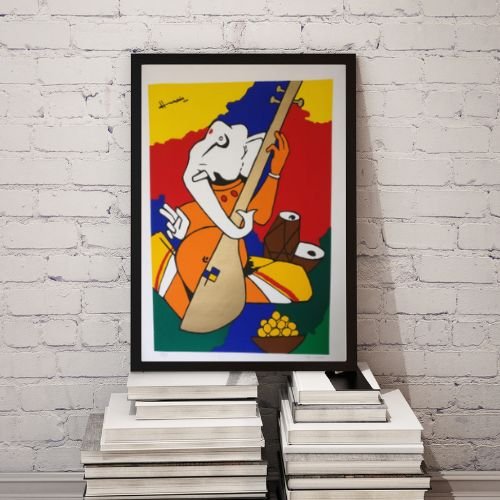
Seller Credibility
Collectors should purchase important works from galleries, auction houses or dealers with strong reputations and transparent documentation.
For valuable works by major Indian artists, specialist advice is highly recommended.
M.F. Husain’s Legacy in Indian Modern Art
M.F. Husain helped redefine what modern Indian art could look like.
He borrowed from mythology without becoming purely traditional.
He embraced modernism without abandoning Indian cultural references.
He explored village life alongside cinema, history and contemporary identity.
His artistic vocabulary was broad enough to include horses, women, musicians, gods, political ideas and ordinary people.
Yet despite this wide range of subjects, his work remained visually consistent.
The sweeping line, simplified figure and energetic composition became unmistakably his own.
That is one reason Husain continues to be recognised long after his death.
His paintings remain relevant to collectors, historians and younger artists because they continue to raise questions about India, identity, modernity and cultural interpretation.
Frequently Asked Questions About M.F. Husain
Who was M.F. Husain?
M.F. Husain, whose full name was Maqbool Fida Husain, was one of the leading figures of modern Indian art. He became known for his expressive paintings of horses, mythology, women, village life and Indian cultural themes.
What was M.F. Husain famous for?
He was famous for his bold modernist painting style, dynamic horse paintings, mythological works and recurring exploration of Indian identity and culture.
What are the most famous M.F. Husain paintings?
His best-known works include his horse paintings, Mother Teresa series, Mahabharata and Ramayana works and Untitled (Gram Yatra).
Why did M.F. Husain paint horses?
Horses allowed Husain to express energy, movement and strength through sweeping lines and simplified forms. Over time, they became one of his artistic signatures.
What was M.F. Husain’s painting style?
His style was characterised by bold lines, simplified or fragmented figures, strong colours, expressive movement and the combination of Indian cultural themes with modernist approaches.
What was M.F. Husain’s most expensive painting?
Untitled (Gram Yatra) sold for $13.75 million at Christie’s in New York on March 19, 2025, setting a new auction record for Husain at the time.
Was M.F. Husain associated with the Progressive Artists’ Group?
Yes. Husain became closely associated with the Bombay Progressive Artists’ Group, which played an important role in shaping modern Indian art after independence.
Why did M.F. Husain leave India?
He faced controversy, protests and legal disputes related to some of his representations of Hindu deities. He later spent much of his final years outside India.
What awards did M.F. Husain receive?
His major Indian civilian honours included the Padma Shri, Padma Bhushan and Padma Vibhushan.
Can you buy M.F. Husain artworks today?
Yes. Original paintings, works on paper, prints and limited editions attributed to M.F. Husain appear through galleries and auction houses. Buyers should carefully verify provenance, authenticity, condition and documentation before purchasing.