
Nandalal Bose was one of the most influential artists in the development of modern Indian art. Known for combining Indian artistic traditions with a fresh modern vision, he played an important role in shaping an artistic identity connected with Indian culture, history, nature, rural life and the freedom movement.
Born on 3 December 1882, Nandalal Bose became closely associated with the Bengal School of Art and studied under the celebrated artist Abanindranath Tagore. He later became one of the central figures of Kala Bhavana at Santiniketan, where his work as an artist and teacher influenced generations of Indian artists.
His importance extends far beyond paintings displayed in galleries. Nandalal Bose created works inspired by Indian mythology, rural life, nature, folk traditions and the freedom movement. He was involved in the celebrated Haripura Posters, created one of the most recognizable artistic images of Mahatma Gandhi and played an important role in the artistic decoration of the original Constitution of India.
His career developed during a period when Indian artists were searching for a visual language that reflected India’s own cultural identity rather than simply following European academic styles. This makes Nandalal Bose an essential figure for anyone interested in Indian paintings, the Bengal School, Santiniketan or the wider history of modern Indian art.
Who Was Nandalal Bose?
Nandalal Bose was an Indian painter, printmaker, teacher and one of the leading figures associated with modern Indian art. He was born on 3 December 1882 in Kharagpur in the Monghyr district of present-day Bihar and died on 16 April 1966 in Santiniketan, as recorded in his Wikipedia biography.
From the early part of his career, Bose became interested in developing an artistic language rooted in Indian traditions. At the time, European academic realism strongly influenced formal art education in colonial India. Artists such as Abanindranath Tagore and Nandalal Bose began looking towards Indian artistic heritage for inspiration and sought to create art that reflected Indian ideas, experiences and cultural traditions.
Bose studied at the Government School of Art in Calcutta and became a student of Abanindranath Tagore. This relationship became one of the most important influences on his artistic development. Rather than treating traditional Indian art as something belonging only to the past, Bose explored how historic painting, folk art, murals, printmaking and everyday Indian life could contribute to a modern artistic practice.
Throughout his long career, he worked across painting, drawing, murals, prints and design. His artistic legacy became closely connected with the Bengal School, Santiniketan, Indian nationalism, Mahatma Gandhi and the visual presentation of the Constitution of India.
Early Life of Nandalal Bose
Nandalal Bose grew up during a period of enormous political, cultural and social change in India. The late nineteenth and early twentieth centuries saw Indian intellectuals, writers and artists increasingly questioning the cultural dominance of colonial institutions.
Art became one of the areas in which these questions were explored most seriously. Formal art education in British India had largely promoted European techniques, styles and standards of representation. A new generation of Indian artists, however, wanted to rediscover India’s own artistic traditions and develop forms of expression that were more closely connected with Indian culture.
Nandalal Bose became one of the most important artists involved in this movement. His interest in art eventually took him to Calcutta, where he entered formal artistic training and became closely associated with Abanindranath Tagore.
Nandalal Bose and Abanindranath Tagore
One of the most important relationships in Nandalal Bose’s artistic career was his association with Abanindranath Tagore. Abanindranath was a leading figure in the Bengal School and encouraged Indian artists to move beyond the conventions of Western academic painting.
Under his guidance, Bose encountered an approach to art that gave renewed importance to Indian traditions. This did not mean simply copying old paintings. Instead, artists were encouraged to study India’s artistic heritage and reinterpret it for a changing society.
Bose absorbed these ideas deeply but eventually developed a visual language that was distinctly his own. Indian miniature painting, the murals of Ajanta, folk traditions, rural life and East Asian artistic techniques all contributed to his evolving style.
The relationship between Abanindranath Tagore and Nandalal Bose therefore became part of a much larger transformation in Indian art. Their work helped challenge the belief that European traditions were the only valid foundation for serious modern art.
What Was the Bengal School of Art?
The Bengal School developed during the late nineteenth and early twentieth centuries and became closely associated with efforts to create a distinctly Indian artistic language. Many artists of the period believed that colonial art education placed too much emphasis on European realism and academic techniques.
The Bengal School instead turned towards Indian miniature traditions, Mughal painting, Rajput art, spiritual themes, historical subjects and influences from other Asian artistic cultures.
Abanindranath Tagore became one of the most prominent figures associated with the movement, while Nandalal Bose became one of its most important artists. However, Bose’s mature work eventually expanded beyond the delicate wash techniques commonly associated with the early Bengal School.
He explored stronger lines, simplified forms, printmaking, murals, landscapes and scenes from rural India. His artistic journey therefore shows how the Bengal School evolved rather than remaining a single fixed style.
Nandalal Bose Art Style
The art style of Nandalal Bose cannot be described through one single technique because he experimented continuously throughout his career. What remained consistent was his interest in connecting traditional Indian art with contemporary life.
His works frequently use strong but graceful lines, simplified forms and carefully balanced compositions. Instead of depending entirely on European methods of realistic modelling and perspective, Bose often emphasized movement, rhythm, silhouette and expressive form.
Nature played an important role in his artistic practice. Trees, rivers, mountains, landscapes, animals and seasonal changes frequently appeared in his work.
He was also deeply interested in ordinary people. Farmers, craftspeople, musicians and village workers became recurring subjects. This helped distinguish Bose from artists who focused mainly on historical, royal or mythological subjects.
His figures often appear simple at first glance, but they carry dignity, character and movement. Through this approach, Bose helped show that everyday life could be an important subject for modern Indian art.
Influence of Ajanta on Nandalal Bose
The ancient murals of Ajanta played an important role in the development of Nandalal Bose’s artistic imagination. The Ajanta caves contain some of India’s most celebrated examples of ancient Buddhist painting and became a major source of inspiration for several artists connected with the Bengal School.
The flowing contours, graceful figures, expressive gestures and sophisticated compositions of the Ajanta murals deeply influenced Bose.
For him, Ajanta was not simply an important historical site. It demonstrated that India possessed a highly developed visual culture long before European academic art became dominant in colonial institutions.
The murals strengthened Bose’s interest in line, narrative, form and large-scale decorative art. Their influence can be understood as part of his wider effort to study India’s artistic past and reinterpret it in ways that felt relevant to modern India.
Japanese and East Asian Influences
Nandalal Bose was also influenced by Japanese and other East Asian artistic traditions. This influence was especially significant at a time when Indian artists were searching for alternatives to European academic art.
Japanese painting demonstrated how traditional artistic principles could coexist with modern cultural expression. Bose explored techniques involving simplified forms, brushwork, spatial balance and controlled composition.
These influences did not make his work less Indian. Instead, they expanded his understanding of how Asian traditions could contribute to the development of modern art.
His artistic practice therefore became a meeting point between Indian heritage, East Asian visual ideas and his own observations of contemporary Indian life.
Nandalal Bose and Santiniketan
Santiniketan became one of the most important places in Nandalal Bose’s life and career. Rabindranath Tagore envisioned Santiniketan as a space where education could develop in closer relationship with nature, culture and creativity.
Art was an important part of this vision.
In 1919, Nandalal Bose accepted Rabindranath Tagore’s invitation to become principal of the newly established Kala Bhavana at Santiniketan. His role there transformed him from an important artist into one of India’s most influential art educators.
At Kala Bhavana, art education was not restricted to classroom exercises or copying models. Students were encouraged to observe nature, study traditional crafts, interact with local communities and experiment with different materials and artistic techniques.
This approach gave Santiniketan a distinctive identity and helped shape a new direction for art education in India.
Nandalal Bose as an Art Teacher
Nandalal Bose’s influence on Indian art cannot be measured only through his own artworks. His role as a teacher was equally important.
He encouraged students to develop their own artistic voices rather than simply imitate their teacher. Art at Santiniketan was closely connected with life, observation and experimentation.
Students studied trees, animals, workers, rural landscapes, festivals and local traditions. They explored drawing, painting, mural work, printmaking and crafts.
This educational philosophy helped produce generations of artists who later contributed significantly to modern Indian art. Through Kala Bhavana, Bose became part of an educational tradition that continues to influence art practice in India.
Nandalal Bose and Rabindranath Tagore
Rabindranath Tagore played an important role in the mature phase of Nandalal Bose’s career. Tagore’s ideas about education, culture and the relationship between India and the wider world strongly shaped Santiniketan.
For Bose, Santiniketan provided an environment where art could be closely connected with nature and daily life.
Their relationship represented an important meeting of literature, education and visual art in twentieth-century India. Both Tagore and Bose believed that creativity could play an important role in education and society.
This shared vision helped make Santiniketan one of the most important cultural centres in modern Indian history.
Nandalal Bose and Mahatma Gandhi
Another important association in Nandalal Bose’s career was his connection with Mahatma Gandhi and the Indian national movement.
Gandhi’s ideas about simplicity, village India, indigenous culture and self-reliance connected naturally with certain aspects of Bose’s artistic approach.
This relationship became especially visible through Bose’s artistic representation of Gandhi and the Haripura Congress project.
One of Bose’s most recognizable images shows Gandhi walking with a staff. The strength of the image lies in its simplicity. Rather than creating a highly detailed portrait, Bose used a strong silhouette, simplified lines and a sense of forward movement.
The work became one of the most familiar artistic representations of Mahatma Gandhi.
Nandalal Bose’s Bapuji
Among the best-known works associated with Nandalal Bose is his linocut image of Mahatma Gandhi, commonly known as Bapuji.
The work depicts Gandhi walking with a staff and is remarkable for its visual economy. The bold black-and-white contrast, the forward movement of Gandhi’s body and the lack of unnecessary detail make the image immediately recognizable.
The work has become closely associated with Gandhi and the history of India’s freedom movement.
It also demonstrates Bose’s interest in printmaking. Printed works could be reproduced and circulated more widely than individual paintings, making printmaking an important medium in an era when visual communication had strong cultural and political value.
The Haripura Posters
The Haripura Posters represent one of the most celebrated chapters in Nandalal Bose’s career. They were created in connection with the Indian National Congress session held at Haripura in Gujarat in 1938.
Rather than filling the event with highly formal or Europeanized imagery, Bose and the artists working with him focused on the life of ordinary Indians.
The resulting images depicted farmers, workers, craftspeople, musicians and people engaged in everyday occupations. The project involved hundreds of works, with a major group painted by Bose himself and additional pieces created by artists working under his guidance.
The Haripura Posters were important because they placed ordinary Indian people at the centre of a major public cultural event.
Why Are the Haripura Posters Important?
The importance of the Haripura Posters goes far beyond decoration.
They represented a broader idea of Indian identity. Instead of defining India only through kings, monuments, myths or elite personalities, the works celebrated ordinary people and everyday forms of labour.
The posters drew inspiration from folk and popular traditions and used direct compositions, strong forms and energetic lines.
Because they were created for a major public gathering, they also demonstrated how art could move beyond galleries and private collections.
The Haripura Posters became part of a wider conversation about independence, culture, national identity and the importance of rural India.
Nandalal Bose and the Constitution of India
Nandalal Bose’s contribution to the original Constitution of India is one of the most historically significant parts of his career.
The handwritten Constitution was not treated simply as a legal document. It was also conceived as an important artistic manuscript.
Prem Behari Narain Raizada was responsible for the calligraphy of the original English manuscript, while Nandalal Bose and artists associated with Kala Bhavana contributed to its visual decoration.
The Constitution contains 22 illustrations connected with different periods of Indian history and culture.
These images create a visual journey across the history of the Indian subcontinent. Ancient civilization, religious traditions, kingdoms, historical personalities and the freedom movement all become part of this artistic narrative.
The result connects India’s modern democratic identity with a much longer cultural history.
Who Illustrated the Constitution of India?
Nandalal Bose is widely associated with the illustrations and artistic decoration of the original Constitution of India.
However, the project was collaborative. Bose guided the artistic work, while artists connected with Kala Bhavana also participated in the decoration of the manuscript.
Prem Behari Narain Raizada was responsible for the handwritten calligraphy.
This distinction is important because the original Constitution represents the combined work of calligraphy, illustration, ornamentation and visual design.
The artistic elements were therefore an important part of the document’s identity rather than simple decoration added afterwards.
How Many Illustrations Are in the Original Constitution of India?
The original Constitution of India contains 22 illustrations.
These illustrations represent different periods and cultural moments from Indian history.
Together, they create a visual narrative that covers a vast historical timeline.
This makes the original Constitution remarkable not only as the foundation of independent India’s legal system but also as an important work of visual culture.
The illustrations associated with Nandalal Bose and the Kala Bhavana team continue to attract interest from historians, artists, students and designers.
Famous Paintings and Artworks by Nandalal Bose
Nandalal Bose created an enormous body of work over several decades. His output included paintings, sketches, drawings, murals, prints, posters and decorative designs.
Because his practice was so broad, it is difficult to represent his entire career through only a few famous works. Nevertheless, several paintings and major projects are regularly discussed when exploring his artistic legacy.
Sati
Sati is frequently mentioned among the notable early works of Nandalal Bose. It belongs to a period when he was exploring themes drawn from Indian mythology, literature and cultural history.
The work reflects the influence of the Bengal School and its interest in emotion, atmosphere and graceful line.
Rather than relying only on detailed realism, paintings from this phase often aimed to create a poetic visual experience.
Works such as Sati helped establish Bose as one of the important emerging artists of his generation.
Bapuji
Bose’s representation of Mahatma Gandhi walking with a staff is among his most recognizable works.
Commonly known as Bapuji, the image is especially significant because it uses linocut printmaking rather than conventional painting.
The figure is simplified but immediately identifiable.
The strong forward movement of Gandhi’s body gives the image a sense of determination, while the black-and-white treatment makes it visually powerful.
The work has become closely connected with representations of Gandhi and India’s freedom movement.
Haripura Posters as Major Artworks
The Haripura Posters should also be considered among Nandalal Bose’s most important achievements.
Although they form a series rather than a single painting, their impact on Indian visual culture has been substantial.
The works depict people engaged in farming, music, craft and everyday labour.
Their simplified shapes, expressive gestures and accessible imagery allowed them to communicate strongly with a public audience.
The series demonstrates how Bose could transform ordinary occupations into meaningful cultural images.
Landscapes and Nature Studies
Nature remained a recurring subject throughout Nandalal Bose’s career.
His landscapes often focused on close observation rather than dramatic grandeur.
Trees, hills, rivers, plants and seasonal changes could become important subjects in their own right.
His time at Santiniketan encouraged this close relationship with the natural environment.
Bose often worked through sketches and direct observation, helping his landscape studies feel immediate and personal.
Rural Life and Everyday People
Some of the most characteristic works by Nandalal Bose focus on ordinary people.
He depicted workers, craftspeople, musicians and people from village communities with great visual sensitivity.
These subjects reflected his belief that Indian art did not need to depend entirely on royal, historical or mythological themes.
Everyday experiences could also carry artistic importance.
This became especially visible in the Haripura Posters, but the same interest can be found throughout his career.
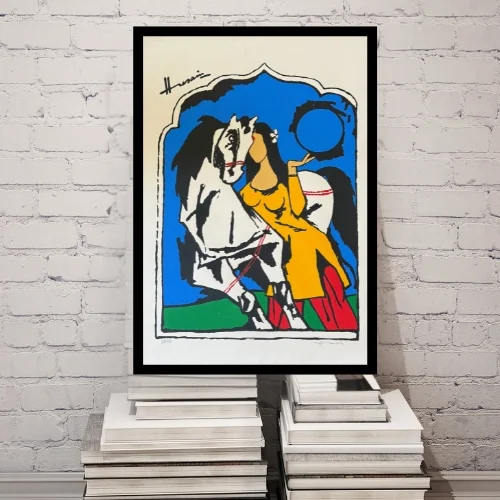
Printmaking by Nandalal Bose
Although Nandalal Bose is often described primarily as a painter, printmaking formed an important part of his artistic practice.
He experimented with techniques such as linocut, lithography and woodcut.
Printmaking allowed him to work with simplified shapes, bold contrasts and expressive lines.
It also allowed multiple copies of an image to be produced, making the medium especially suitable for wider circulation.
His ability to move between painting, drawing, murals and prints shows how experimental his artistic practice was.
Murals and Large-Scale Art
Murals were another important part of the artistic environment at Santiniketan.
Large-scale wall painting allowed art to become part of architecture, education and shared public spaces.
Bose’s interest in the historic murals of Ajanta influenced this aspect of his practice.
At Santiniketan, artists were encouraged to think beyond framed paintings. Walls, buildings, festivals and educational spaces could also become places for artistic expression.
This helped broaden the role of art in everyday life.
Nandalal Bose and Folk Art
Folk traditions were particularly important to Bose because they represented living artistic practices.
India’s craftspeople and rural artists had developed visual languages outside the formal structures of colonial art education.
Bose studied these traditions carefully and learned from their directness, rhythm, simplified forms and decorative qualities.
His goal was not to simply copy folk painting.
Instead, he absorbed its visual principles and incorporated them into a broader modern artistic language.
The Haripura Posters are one of the clearest examples of this approach.
Nandalal Bose and Indian Nationalism
Nandalal Bose’s career developed during India’s struggle against colonial rule.
Art and cultural identity became closely connected during this period, although not every artwork he created should be interpreted as direct political propaganda.
For artists connected with the Bengal School and Santiniketan, the recovery of Indian visual traditions carried broader cultural significance.
Colonial educational systems had often treated European artistic traditions as universal standards. Artists such as Bose challenged that assumption by demonstrating the sophistication and continued relevance of Indian art.
His interest in rural life, Indian history, folk culture and indigenous artistic techniques therefore became part of a wider cultural movement.
The Haripura Posters and his images connected with Mahatma Gandhi made this relationship between art and national identity especially visible.
Nandalal Bose’s Contribution to Modern Indian Art
Nandalal Bose’s contribution to modern Indian art can be understood in several important ways.
He helped demonstrate that Indian artists did not need to imitate European art in order to be modern.
He showed that Indian artistic history, traditional craft, folk art and contemporary life could all become meaningful sources for modern expression.
He also expanded the range of subjects considered suitable for serious art.
Village workers, craftspeople, landscapes, animals, plants and everyday experiences became important themes.
His role as a teacher at Kala Bhavana also connected art with education, observation and experimentation.
Through the Haripura Posters, his representations of Gandhi and the artistic decoration of the Constitution, Bose brought art directly into public and national life.
Few artists of his generation influenced so many areas simultaneously.
Nandalal Bose as a Cultural Modernist
The idea of modern art can sometimes create confusion when discussing Indian artists.
Modernity does not always require the rejection of tradition.
For Nandalal Bose, modern Indian art could emerge through a deeper understanding of the past.
Ajanta murals, miniature paintings, folk traditions and East Asian art were not styles that he simply copied.
They were artistic languages from which he learned important principles.
His modernism therefore developed through a dialogue between history and the present.
This approach allowed his work to remain rooted in Indian cultural memory while still responding to a rapidly changing society.
Awards and Recognition
Nandalal Bose received significant recognition during his lifetime.
Among his most important honours was the Padma Vibhushan, one of India’s highest civilian awards.
He also received academic recognition and became widely respected as both an artist and an educator.
However, his true importance can be seen in the continued presence of his work in museums, exhibitions, textbooks, academic discussions and studies of Indian art.
The National Gallery of Modern Art holds thousands of his works, making his artistic legacy accessible to researchers, students and the general public.
Nandalal Bose’s Legacy
Nandalal Bose’s legacy continues through several areas of Indian culture.
He strengthened the Bengal School while also expanding beyond its early conventions.
He played a major role in the development of Kala Bhavana at Santiniketan.
He influenced generations of students and helped bring folk and rural artistic traditions into modern Indian art.
He also contributed to India’s national visual culture through the Haripura Posters and images associated with Gandhi.
Most significantly, his artistic direction became part of the original Constitution of India.
Few Indian artists have been connected so closely with painting, art education, cultural history and national identity.
Where Can You See Nandalal Bose’s Art?
Works by Nandalal Bose can be seen in major institutional collections in India.
The National Gallery of Modern Art holds one of the most important collections of his work, including paintings, drawings, sketches, prints and material related to the Haripura project.
Santiniketan is also an important place for understanding his legacy because of his long association with Kala Bhavana.
Museums and exhibitions focusing on modern Indian art frequently include Bose because of his central role in the development of twentieth-century Indian art.
For anyone studying his work seriously, viewing museum collections alongside digital reproductions can provide a better understanding of the range of techniques and subjects he explored.
Understanding Original Works and Reproductions
Because Nandalal Bose is a historically important artist, buyers and collectors should clearly distinguish between original artworks, reproductions, decorative prints and contemporary works inspired by his style.
A print of a Nandalal Bose image is not automatically an original artwork simply because it reproduces one of his compositions.
Authentic works by historically significant artists require careful provenance and documentation.
Anyone considering a major art purchase should examine ownership records, supporting documentation and expert authentication where appropriate.
For decorative purposes, reproductions can still allow people to appreciate important artworks, but they should always be clearly identified as reproductions.
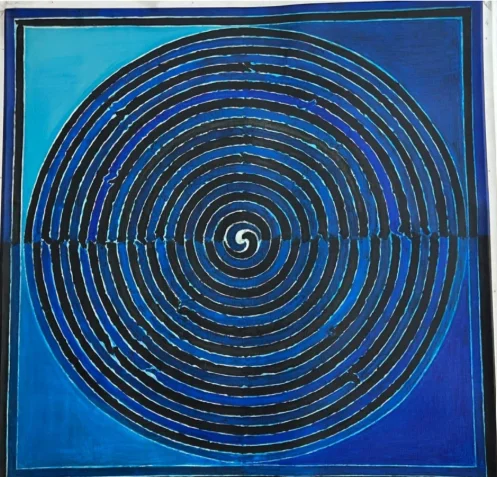
Nandalal Bose and Indian Art Today
The influence of Nandalal Bose can still be felt in contemporary Indian visual culture.
His belief that artists could learn from traditional and folk art without simply copying it remains highly relevant.
Contemporary artists often move between painting, craft, illustration, printmaking, design and public art in ways that reflect the interdisciplinary environment encouraged at Santiniketan.
His interest in ordinary people also remains important.
Instead of presenting Indian identity as one fixed image, Bose showed that it could be found in landscapes, workers, crafts, festivals, history and everyday experiences.
This range is one reason his work continues to feel relevant today.
Bringing Indian Art Into Contemporary Spaces
The renewed interest in Indian art history has also encouraged more people to bring Indian-inspired artwork into homes and workplaces.
Traditional and modern Indian art can work particularly well when selected for its visual character, cultural significance and connection with the surrounding space.
A work influenced by folk traditions can introduce rhythm and warmth into a modern interior, while landscapes and nature-inspired paintings can create a quieter and more reflective atmosphere.
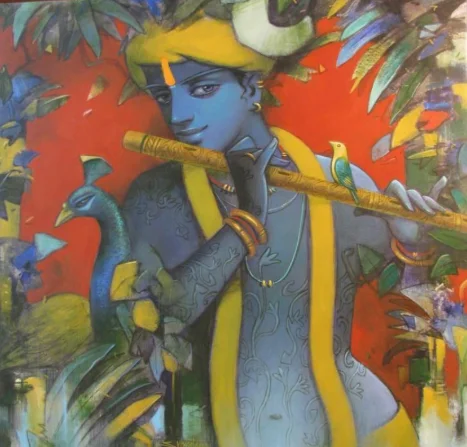
Indian art can also establish meaningful connections with culture, memory and identity.
For people exploring paintings for contemporary interiors, understanding artists such as Nandalal Bose provides useful context for appreciating the traditions that influenced later generations of Indian artists.
At The Brush Strokes Co., art lovers can explore paintings across different styles, subjects and visual traditions when choosing artwork for homes, offices and gifting.
Why Nandalal Bose Still Matters
More than a century after Nandalal Bose began his artistic career, his work remains deeply connected with discussions about Indian art and identity.
He did not see tradition and modernity as complete opposites.
Instead, he demonstrated that new art could emerge through serious engagement with cultural memory.
He also expanded the idea of where art belonged.
Art could exist in galleries, but it could also appear on the walls of Santiniketan, at a political gathering, in a printed image of Gandhi or within the pages of India’s Constitution.
This openness gave his artistic career extraordinary range.
Nandalal Bose was therefore not simply a painter of beautiful images.
He was an artist, teacher and cultural thinker who helped redefine the relationship between Indian art, education, history and national identity.
FAQ About Nandalal Bose
Who was Nandalal Bose?
Nandalal Bose was an influential Indian artist, printmaker and art educator associated with the Bengal School and Santiniketan. He studied under Abanindranath Tagore and later became a leading figure at Kala Bhavana. His work played an important role in the development of modern Indian art.
When was Nandalal Bose born?
Nandalal Bose was born on 3 December 1882 in Kharagpur in the Monghyr district of present-day Bihar.
When did Nandalal Bose die?
Nandalal Bose died on 16 April 1966 in Santiniketan.
Who was Nandalal Bose’s teacher?
Abanindranath Tagore was one of the most important teachers in Nandalal Bose’s artistic development. His ideas strongly influenced Bose’s early approach to Indian art and the Bengal School.
What is Nandalal Bose famous for?
Nandalal Bose is famous for his contribution to modern Indian art, his association with the Bengal School, his work at Kala Bhavana, the Haripura Posters, his representation of Mahatma Gandhi and his role in the artistic decoration of the original Constitution of India.
What was the art style of Nandalal Bose?
Nandalal Bose’s art combined influences from Indian miniature painting, Ajanta murals, folk art, rural life and East Asian artistic traditions. His work often used expressive lines, simplified forms, balanced compositions and a strong interest in nature and everyday life.
Was Nandalal Bose a Bengal School artist?
Yes, Nandalal Bose was closely associated with the Bengal School and studied under Abanindranath Tagore. However, his mature work developed beyond the early style of the movement and included folk art, landscapes, printmaking, murals and modern interpretations of Indian life.
What are the Haripura Posters?
The Haripura Posters were created for the 1938 session of the Indian National Congress at Haripura. Nandalal Bose and artists working with him produced images showing people involved in farming, craft, music and other everyday activities.
What is Nandalal Bose’s connection with Mahatma Gandhi?
Nandalal Bose created one of the most recognizable artistic representations of Mahatma Gandhi. His well-known linocut depicts Gandhi walking with a staff and became closely associated with the freedom movement.
Did Nandalal Bose illustrate the Constitution of India?
Nandalal Bose directed the artistic work connected with the illustrations and decoration of the original handwritten Constitution of India, working with artists from Kala Bhavana.
How many illustrations are there in the original Constitution of India?
The original Constitution of India contains 22 illustrations representing different periods, cultural traditions and historical themes from Indian history.
Who wrote the original Constitution of India by hand?
The calligraphy of the original English manuscript was completed by Prem Behari Narain Raizada, while Nandalal Bose and artists from Kala Bhavana contributed to its artistic decoration.
What are some famous works by Nandalal Bose?
Some of the most widely discussed works and projects associated with Nandalal Bose include Sati, Bapuji, the Haripura Posters, his landscapes, rural-life studies, prints and the illustrations associated with the Constitution of India.
What techniques did Nandalal Bose use?
Nandalal Bose worked across painting, drawing, murals and printmaking. His practice included watercolour, tempera, ink, pencil, linocut, lithography, woodcut and mural techniques.
Where can Nandalal Bose’s artworks be seen?
Many works by Nandalal Bose are held by the National Gallery of Modern Art in India. His legacy is also closely connected with Kala Bhavana and Santiniketan.
Why is Nandalal Bose important to Indian art?
Nandalal Bose helped establish a modern Indian artistic language rooted in Indian culture rather than relying entirely on European academic traditions. His work as an artist and teacher influenced generations of Indian artists and connected visual art with education, history, everyday life and national identity.