
The first thing most people notice about a Cheriyal scroll painting is the red. It is a deep, confident red that fills the background and makes every figure in front of it look as though it is stepping onto a stage. That impression is closer to the truth than you might expect, because these paintings were made to be performed.
A Cheriyal scroll painting is a narrative folk art from Telangana, painted by hereditary Nakashi artists on prepared khadi cloth. For centuries, travelling balladeers carried these long scrolls from village to village, unrolling them panel by panel while they sang stories from the Ramayana, the Mahabharata, the Puranas, and local legend.
This guide walks you through where the art comes from, how it is made, how to read its colours, how it differs from Phad painting, and how to choose, style, and care for a piece in a modern home.
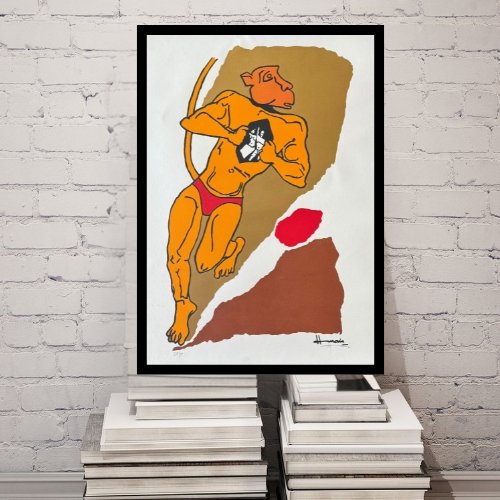
Cheriyal Scroll Painting at a Glance
| Detail | Fact |
|---|---|
| Origin | Cheriyal, Siddipet district, Telangana |
| Artists | Nakashi painter families |
| Original users | Kaki Padagollu storytelling community |
| Base surface | Khadi or cotton cloth coated with starch, white clay and tamarind seed paste |
| Signature colour | Red background with bold primary colours |
| Format | Long scrolls with up to about 50 panels; single framed panels today |
| GI status | Registered as “Cheriyal Paintings,” GI application No. 190 (filed November 2009) |
| Common subjects | Ramayana, Mahabharata, Krishna Leela, Shiva and Markandeya Puranas, community legends, village life |
What Makes Cheriyal Scroll Painting Unique
Most paintings ask you to stand still and take in a single moment. A Cheriyal scroll painting was never meant to hang still. It worked more like a film reel. Each panel held one episode, and a full scroll could carry an entire epic across roughly fifty frames.
A few traits set it apart from other Indian folk traditions:
- A red ground almost everywhere. The GI application itself records red as the main background of Cheriyal paintings.
- Flat, unshaded colour. There is no gradient or modelling. Each shape is a clean block of colour.
- Confident black outlines. Fine dark lines define faces, jewellery, clothing and architecture.
- Floral border bands. Horizontal bands of flowers and creepers separate one scene from the next.
- Size follows importance. Gods and heroes appear larger than the people around them, so an audience could spot the main character instantly.
That combination gives the art its unmistakable rhythm. Even a small framed panel feels like one chapter of a much longer book.
Where Cheriyal Scroll Painting Comes From
Cheriyal scroll painting is from Telangana, India. It takes its name from Cheriyal, a town in present-day Siddipet district, which has long been the home of the Nakashi painting families. Today many of these families also work from Hyderabad, where buyers and workshops are easier to reach.
The craft’s regional identity is legally protected. “Cheriyal Paintings” is a registered Geographical Indication under application number 190 on India’s GI Registry, filed by the Cheriyal Nakashi Chitrakala Trust. Several working artists from the Dhanalakota family are listed there as registered authorised users, which is useful to know when you are checking who made a piece.
You will see different dates for the GI tag online, from 2007 to 2010. The registry record shows the application was filed on 20 November 2009 and published in the GI Journal in June 2010, so those are the most reliable dates to quote.
Is Cheriyal Telangana or Andhra Pradesh?
Both answers appear in older sources, and both are understandable. When the GI application was filed, Cheriyal sat in Warangal district of undivided Andhra Pradesh. Telangana became a separate state in 2014, and Cheriyal later became part of Siddipet district. The art has always belonged to the same place. Only the map around it changed.
The Storytellers Who Unrolled Every Scroll
The history of Cheriyal scroll painting is inseparable from a community of balladeers called the Kaki Padagollu. They travelled across the Telangana countryside with rolled scrolls, set up in a village square, and performed stories over long evenings with song and narration. As the story moved forward, the scroll was unrolled to show the next scene.
The scrolls themselves were enormous. A Ministry of Textiles compendium of GI-protected crafts describes traditional Cheriyal scrolls running between 10 and 30 metres. Scenes were also chosen for the audience. According to Telangana Tourism’s account of the craft, these paintings served as a visual way to share mythology and folk narratives with communities, many of whom could not read.
The tradition shares roots with other Indian textile scroll arts such as Patachitra and Phad, as noted in Wikipedia’s overview of Cheriyal scrolls. The GI documentation goes further and links the painters’ lineage to artists once associated with the Vijayanagara court.
Then cinema and television arrived. As village audiences turned to new entertainment, demand for long performance scrolls fell sharply. The painters survived by adapting. They began making single framed panels, masks and dolls for homes, collectors and museums, a shift documented by The News Minute’s reporting on how Cheriyal art has evolved.

Meet the Nakashi Artists Behind It
Every authentic Cheriyal scroll painting traces back to the Nakashi community, a small group of hereditary painter families. Children learned by watching and helping. They prepared cloth, ground colours, filled in flat areas, and slowly earned the right to draw faces and outlines, which are the hardest parts.
The best-known name is D. Vaikuntam Nakash, a national award-winning master widely credited with keeping the craft alive when few practitioners remained. His work has been used well beyond the gallery. A Telangana NGO, Kudali Centre, has used one of his scroll paintings to teach farmers about organic farming, which shows that the storytelling purpose of the art still works today.
The next generation is active too. Artists such as D. Vinay Kumar continue the family practice, and family workshops often divide the labour. One account from the region notes that a 3 ft by 5 ft scroll can take a whole family about a month to complete. That is worth remembering when you compare prices.
Nakashi families also make lightweight masks and figurines of gods, villagers and animals, using wood, sawdust and tamarind paste. Seeing these alongside the paintings helps you understand that Cheriyal is a complete visual culture, not just a painting style.
Inside the Cheriyal Painting Material Kit
A traditional Cheriyal scroll painting starts with cloth, not canvas or paper. Here is what goes into one:
- Khadi or cotton cloth. A natural, breathable base that can be rolled without cracking.
- The coating. Rice starch, white clay (sometimes called white mud) and tamarind seed paste, often with natural gum. It is applied in layers, with drying time between each one, to create a smooth, firm surface.
- Pigments. Historically drawn from natural and mineral sources. Sources commonly describe white from sea shells, black from lamp soot and yellow from turmeric.
- Brushes. Traditionally fine brushes of squirrel hair tied to a stick, which allow the long, steady outlines the style is known for.
Many contemporary artists now use poster or acrylic colours, especially for smaller works meant for homes. That is a normal evolution of a living craft, not a problem in itself. What matters is that the seller tells you honestly which materials were used, because it affects framing, light exposure and long-term care.
How a Cheriyal Scroll Comes Alive
Making a Cheriyal scroll painting follows a slow, layered sequence. Workshops vary a little, but the broad stages look like this:
- Prepare the cloth. Coat the khadi in the starch, clay and tamarind mixture, letting each layer dry fully.
- Plan the panels. Divide the surface into scenes and mark the border bands that separate them.
- Sketch the figures. Draw directly with a fine brush, often freehand, placing the main deity or hero largest.
- Lay the red ground. Fill the background with the signature red.
- Fill the flat colours. Add blues, yellows, greens, whites and skin tones in clean, unshaded blocks.
- Outline and detail. Finish with black lines that sharpen faces, ornaments, fabric patterns and architecture.
- Dry and finish. Let the piece cure fully, then roll it for storage or frame it for display.
The outlining stage is where you can see an artist’s maturity. Lines that swell and taper naturally, without hesitation marks, usually come from years of practice.
Reading the Colours Like a Storyteller
Colour in Cheriyal art is a language, not decoration. Once you know a few conventions, a panel becomes much easier to read:
- Red forms the background and makes everything in front of it stand out clearly, even by lamplight.
- Blue commonly marks divine figures such as Krishna and Vishnu.
- Darker tones are often used for demons and villains.
- Yellow, pink and brown usually appear on human figures and everyday characters.
- Green and white fill in trees, fields, animals, clothing and decorative borders.
These are tendencies rather than strict rules, and individual artists play with them. Still, they explain why a Cheriyal scroll painting reads clearly from across a room. The colours tell you who matters before you know the story.
For a deeper look at how strong colour works on a wall, our guide to colour theory for art and interiors explains why bold palettes need calm surroundings.
Stories You Will Find Inside Panels
The subjects of a Cheriyal scroll painting fall into a few broad families:
- Epics. Episodes from the Ramayana and Mahabharata.
- Puranic tales. Shiva Puranam, Markandeya Puranam and stories of Krishna.
- Community legends. Origin stories of particular communities, with episodes chosen to suit the audience a scroll was made for.
- Village life. Farmers in fields, musicians, festivals, processions and animals.
Village scenes are especially popular for homes today, because they feel warm and familiar to almost anyone. Mythological panels, on the other hand, carry more devotional weight and suit puja rooms or entrance walls.
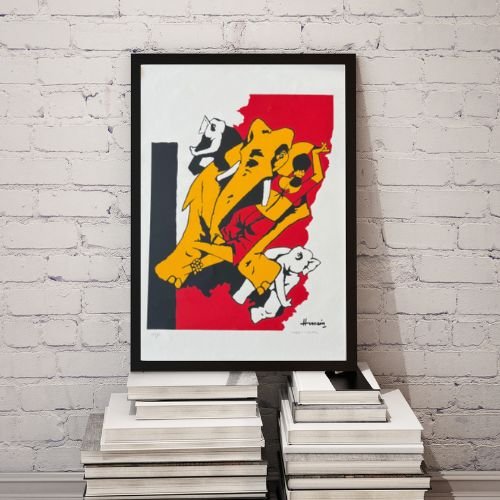
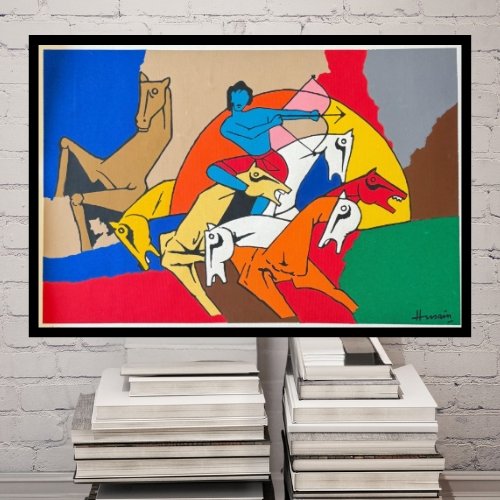
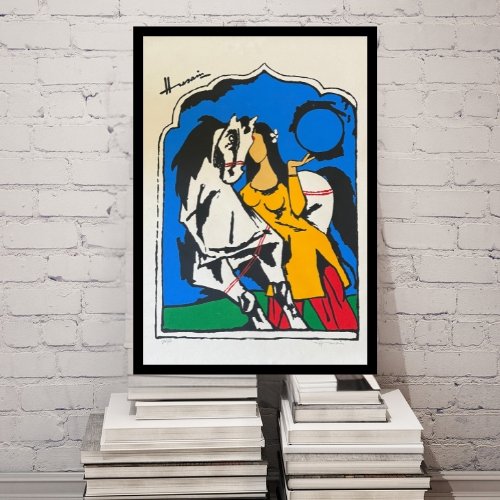
The same gods and epics have inspired Indian artists across every era, from village scroll painters to modern masters such as M.F. Husain. If you enjoy art that carries a narrative, you may also like our piece on art that tells a story.
Cheriyal Versus Phad Side by Side
Cheriyal and Phad are both Indian narrative cloth scrolls, so they are often confused. A side-by-side comparison makes the differences clear.
| Feature | Cheriyal Scroll Painting | Phad Painting |
|---|---|---|
| Region | Cheriyal, Telangana | Shahpura and Bhilwara, Rajasthan |
| Painter community | Nakashi families | Joshi families |
| Performers | Kaki Padagollu balladeers | Bhopa priest-singers |
| Background | Predominantly red | Natural cloth with yellow, orange and red tones |
| Layout | Scenes in separate panels divided by border bands | One continuous composition grouped around a large central deity |
| Main subjects | Epics, Puranas, community legends, village life | Folk deities Pabuji and Devnarayan |
| Modern formats | Single panels, masks, dolls | Smaller phads and framed sections |
In short, Cheriyal tells a story in tidy chapters, while Phad spreads the whole story across one crowded stage. Read more in our full Phad painting guide or the Wikipedia entry on Phad. If South Indian cloth traditions interest you, our Kalamkari painting guide covers a neighbouring craft with a very different technique.
How to Spot Genuine Nakashi Work
Printed copies of Cheriyal art are common, and some are sold without clear labelling. Before you buy a Cheriyal scroll painting, run through these checks:
- Look at the outlines up close. Hand-drawn lines vary slightly in thickness. Printed lines are perfectly even and sit flat.
- Check the surface. Hand-applied colour has a subtle texture. Tilt the piece against the light and look for brush direction.
- Look at the back. On a hand-painted cloth piece, colour often shows faintly through. A print usually leaves the reverse blank.
- Ask for the artist’s name. The Nakashi community is small. A reputable seller should be able to name the artist or family workshop.
- Ask about materials. Cloth with a traditional coating, or a contemporary paper or board base, are both legitimate, as long as you are told which one you are buying.
- Be wary of very low prices. A detailed hand-painted panel takes days or weeks. A price that seems too good usually means a print.
A paper or board surface does not automatically mean a fake. Many genuine contemporary Nakashi artists work on smaller formats. Honest description matters far more than the surface itself. The same principle applies to any art purchase, which is why our guide on art prints versus original paintings is worth a read.
Styling Cheriyal Art in Modern Homes
A Cheriyal scroll painting brings energy to a room in a way few artworks can. The trick is to give that energy space. Here is how placement typically works best:
| Room | Best Format | Why It Works |
|---|---|---|
| Living room | One large panel or a row of three | Creates a cultural focal point above a sofa or console |
| Dining room | Panels hung in sequence | Echoes the scroll’s original chapter-by-chapter rhythm |
| Entryway | Medium single panel | Red reads clearly in passing, even in low light |
| Study or reading nook | Small framed panel | Fine detail rewards close, quiet viewing |
| Puja corner | Mythological panel | Devotional subjects suit a space for reflection |
A practical example: in a compact city flat with white walls and a teak sideboard, a row of three small village-life panels above the sideboard can do more than one big canvas. The eye reads them left to right like a story, and the red picks up the warmth of the wood.
Hang the centre of the artwork at roughly eye level, and leave generous wall space on each side so the busy composition does not compete with other frames.
Pairings That Let Red Breathe
- Walls. Ivory, warm white, sand and soft grey work best. Avoid strong patterned wallpaper.
- Frames. Natural wood or dark walnut suits traditional panels. A slim black frame sharpens a modern room.
- Materials. Brass, terracotta, cane and handloom cushions echo the handmade character of the art.
- Companions. Pair one Cheriyal panel with quieter pieces such as a sculpture or a soft abstract, rather than several equally bold paintings.
Exploring other folk traditions for a gallery wall? Our guides to Madhubani painting, Gond art and Indian folk artwork will help you mix styles without visual clutter.
Mistakes That Dull a Folk Painting
Even a beautiful Cheriyal scroll painting can lose its impact if it is hung carelessly. Watch out for these common errors:
- Crowding it. Bold red art next to several other busy pieces turns into visual noise.
- Hanging it too high. Panels above doorways or near the ceiling hide the detail that makes the art special.
- Ignoring light. A sunny west-facing wall will fade pigments faster than you expect.
- Treating every red folk painting as Cheriyal. Several regional styles share warm palettes. Ask before you buy.
- Skipping the subject. Ask what story a panel shows. Knowing it makes the piece far more meaningful to live with, and to explain to guests.
Caring for Cloth Paintings Through Monsoon
Cloth-based art responds to its environment, and Indian monsoons are a real test. The Canadian Conservation Institute’s basic textile care guidance explains that excess humidity can lead to mould, while light damage is cumulative and cannot be reversed. For a Cheriyal scroll painting, that translates into a few simple habits:
- Keep it out of direct sun. Choose a wall that never gets strong afternoon light.
- Avoid damp walls. Bathrooms, kitchens and walls that show seepage are poor choices.
- Frame with care. Use UV-filtering glazing and a mount or spacer so the glass does not press against the paint.
- Dust gently. Use a soft, dry brush or cloth. Never use water, sprays or household cleaners.
- Store it rolled, not folded. If you rotate art seasonally, roll the painting with the image facing outward around a wide tube, wrapped in clean cotton.
- Check twice a year. Look for spots, flaking or insect activity, especially after the rains.
For older or valuable scrolls, consult a professional art or textile conservator before attempting any cleaning or repair.
A Thoughtful Gift With a Story
A Cheriyal scroll painting makes a meaningful gift because it arrives with something to talk about. The recipient is not just getting a decorative piece. They are getting a story, a region and a family of artists behind it.
It works especially well for:
- Housewarmings, where a village-life panel brings instant warmth. See our housewarming gift ideas.
- Diwali and festive gifting, where mythological panels feel fitting. Browse festive art gifts or our Diwali gift guide.
- Corporate gifting, where handmade heritage art reflects care. Explore corporate art gifts.
- Weddings, where a panel of a celebration or procession suits the occasion. See wedding art gifts.
Include a short handwritten note explaining what Cheriyal art is and what the panel depicts. It turns a beautiful object into a memorable one. For more occasion-led ideas, visit our gifting collection.
FAQ
What is Cheriyal scroll painting?
Cheriyal scroll painting is a narrative folk art from Telangana, made by Nakashi artists on coated khadi cloth. Its red backgrounds and sequential panels were used by travelling storytellers to narrate epics and local legends.
Cheriyal scroll painting is from which state?
It is from Telangana, India, centred on the town of Cheriyal in Siddipet district. Many Nakashi families now also work in Hyderabad.
Who makes Cheriyal scroll paintings?
They are made by the Nakashi community, hereditary painter families who pass skills down through generations. D. Vaikuntam Nakash is among the best-known masters.
When did Cheriyal paintings get the GI tag?
“Cheriyal Paintings” is registered under GI application No. 190. The application was filed in November 2009 and published in the GI Journal in June 2010.
What materials are used in Cheriyal painting?
Traditional works use khadi or cotton cloth coated with rice starch, white clay and tamarind seed paste, painted with natural or mineral pigments. Many contemporary pieces use poster or acrylic colours.
Why is red used so much in Cheriyal art?
A red background is the defining trait of the style and is recorded as such in the GI application. It creates strong contrast, so figures stand out clearly during a performance.
What is the difference between Cheriyal and Phad painting?
Cheriyal comes from Telangana, uses red grounds and separate panels, and depicts epics and community legends. Phad comes from Rajasthan, uses one continuous composition, and centres on folk deities Pabuji and Devnarayan.
How can I tell if a Cheriyal painting is handmade?
Look for slight variation in outline thickness, visible brush texture and colour showing on the reverse. Ask the seller to name the artist and the materials used.
Where should I hang a Cheriyal scroll painting at home?
Living rooms, dining rooms, entryways and studies all work well. Choose a calm, neutral wall at eye level, away from direct sunlight and damp.
How do I care for a Cheriyal painting?
Keep it away from sunlight and humidity, frame it with UV-filtering glass and a spacer, and dust only with a soft dry brush. Consult a conservator for older pieces.
Bringing a Living Tradition Home
A Cheriyal scroll painting is more than red paint on cloth. It carries centuries of village performances, a family craft that refused to disappear, and a visual language that still communicates clearly today. Knowing its history, materials and colour codes helps you choose a piece with confidence and display it in a way that honours the artists behind it.
If you are building a home filled with meaningful Indian art, explore our original paintings collection, browse curated art collections, or meet the Indian artists we represent. Looking for a specific folk style such as Cheriyal? Contact our art team to check current availability and get help choosing a piece for your space.