
Ajanta paintings are among the finest surviving examples of ancient Indian mural painting. Created on the walls and ceilings of the rock-cut Ajanta Caves in Maharashtra, these works are closely associated with Buddhism and depict scenes from the life of the Buddha, Jataka tales, Bodhisattvas, royal courts, animals, musicians, dancers, attendants, and everyday life.
The paintings are admired not only for their religious importance but also for their sophisticated use of line, colour, expression, movement, composition, and storytelling.
Located near Chhatrapati Sambhajinagar, formerly known as Aurangabad, the Ajanta Caves were developed over different historical periods. The surviving paintings reveal the artistic achievements of ancient India and offer valuable insights into clothing, jewellery, architecture, court culture, spiritual life, and society.
Unlike ordinary wall decoration, Ajanta painting formed part of a much larger Buddhist monastic environment. Painting, sculpture, architecture, storytelling, and worship were brought together within the caves to create deeply immersive sacred spaces.
Today, Ajanta is recognised as a UNESCO World Heritage Site and remains one of the most important monuments in the history of Indian art.
Ajanta Paintings Quick Facts
| Detail | Information |
| Art form | Ancient Buddhist mural painting |
| Location | Ajanta Caves, near Chhatrapati Sambhajinagar (Aurangabad), Maharashtra |
| Setting | Horseshoe-shaped gorge above the Waghora River |
| Early phase | Around 2nd to 1st century BCE (Satavahana period) |
| Later phase | Mainly 5th century CE (Vakataka patronage) |
| Number of caves | 30 including unfinished caves (per UNESCO) |
| Technique | Pigments on prepared plaster, tempera or secco-like method |
| Key pigments | Red and yellow ochre, green earth, carbon black, lime white, lapis lazuli blue |
| Most famous painting | Bodhisattva Padmapani, Cave 1 |
| Key painted caves | 1, 2, 9, 10, 16 and 17 |
| Rediscovered | 1819, by British officer John Smith |
| UNESCO status | World Heritage Site since 1983 |
History and Origin of Ajanta Paintings
The Ajanta Caves were created in a horseshoe-shaped gorge overlooking the Waghora River in present-day Maharashtra.
The site developed in more than one phase rather than being constructed at a single moment.
The earliest activity at Ajanta began around the second to first centuries BCE. A major second phase followed several centuries later, particularly during the fifth century CE.
These two broad periods reflect changes in Buddhist religious practice, architecture, patronage, sculpture, and painting.
The caves were used by Buddhist monks for worship, study, meditation, teaching, and communal life.
Some caves functioned as monasteries, known as viharas, while others served as prayer halls or chaityagrihas.
Painting formed an important part of these spaces.
Walls, pillars, ceilings, doorways, and interior surfaces were decorated with narrative and devotional images designed to communicate Buddhist ideas while also creating visually rich interiors.
The Two Major Periods of Ajanta Painting
Understanding the two main phases of Ajanta is important because the paintings were not all created in exactly the same artistic or historical context.
Early Ajanta Paintings
The earliest phase of Ajanta is generally associated with the Satavahana period.
Important early caves include Caves 9 and 10, which are chaitya halls.
Only fragments of early paintings survive today, but they show that painted decoration was already an important part of Buddhist religious architecture.
The earlier tradition relied heavily on Buddhist narrative subjects and symbolic representation.
The survival of these paintings is particularly important because relatively few examples of ancient Indian painting from this period remain.
Later Ajanta Paintings
The second and more visually celebrated period developed primarily during the fifth century CE.
This phase flourished under the Vakatakas and associated patrons.
Caves such as 1, 2, 16, and 17 contain some of Ajanta’s best-known paintings.
The later murals display greater complexity in facial expression, modelling, ornament, costume, architecture, spatial organisation, and narrative storytelling.
This period is sometimes broadly discussed within the cultural context of Gupta-period India because of stylistic similarities and the wider artistic environment of the age.
However, Ajanta itself was primarily developed under Vakataka patronage during this later phase.
Buddhism and the Ajanta Paintings
Buddhism is central to understanding Ajanta.
The paintings were created within a Buddhist monastic and devotional environment, and many of their subjects are connected with Buddhist teachings. The Metropolitan Museum of Art’s essay on Buddhism and Buddhist art offers useful background on how these ideas shaped visual traditions.
Some scenes portray events from the historical Buddha’s life.
Others depict Bodhisattvas, spiritually advanced beings associated with compassion and enlightenment.
Jataka tales also play an especially important role.
These stories describe the previous births of the Buddha, when he appeared in different forms and demonstrated virtues such as generosity, wisdom, compassion, patience, and sacrifice.
Because many people encountered religious teachings visually, paintings allowed complex stories and moral ideas to be communicated in memorable ways.
At the same time, Ajanta’s painters included detailed scenes of royal life, clothing, jewellery, architecture, travel, music, nature, and social interaction.
This combination means the murals are important not only for Buddhist history but also for understanding aspects of ancient Indian society. The same calm, contemplative spirit continues to inspire modern Buddha paintings created for homes today.
Ajanta Painting Technique
The Ajanta murals are often casually called frescoes, but their technique differs from traditional European buon fresco, in which pigments are applied directly onto wet lime plaster.
The rock surfaces at Ajanta first had to be prepared carefully.
Artists and craftsmen covered uneven stone walls with layers of plaster or earthen material to produce a smoother painting surface.
The base preparation could include local soil and organic plant material that helped bind and stabilise the layer. Smarthistory’s guide to the caves of Ajanta describes this layered preparation in more detail.
A finer surface was then prepared above it.
Once the painting ground was ready, artists planned their compositions and applied outlines and pigments.
The colours were generally applied onto a prepared, relatively dry surface using a technique often described as tempera or secco-like painting.
This method allowed artists to develop detailed outlines, shading, facial features, jewellery, fabrics, architectural elements, and decorative patterns.
The process required careful coordination between surface preparation, drawing, colour application, and finishing.
Colours Used in Ajanta Paintings
Colour is one of the most remarkable features of the surviving Ajanta murals.
Despite their age, many areas still retain traces of rich reds, yellows, greens, browns, whites, blacks, and blues.
Artists relied largely on natural mineral and earth-based pigments.
Red and yellow ochres produced many of the warm tones visible throughout the murals.
Green-earth pigments were used for green tones.
Black could be produced from carbon-based materials, while pale grounds and highlights could include lime or other light mineral materials.
One particularly notable colour is blue.
Natural ultramarine derived from lapis lazuli has been identified in selected parts of Ajanta. Because lapis lazuli was not locally available and was historically associated with regions such as Afghanistan, its presence demonstrates the movement of valuable materials through long-distance trade networks. A 2025 study on the use of blue in the Ajanta paintings found that lapis lazuli was absent from the earliest paintings and appeared only in the fifth-century phase.
Ajanta’s painters did not simply fill flat areas with colour.
They used variations in tone to model faces and bodies, suggest volume, define fabrics, create depth, and direct attention within complex compositions. Many of these principles still guide colour theory in art and interiors today.
Main Features of Ajanta Paintings
Ajanta paintings have several distinctive characteristics that make them important in the history of Indian art.
Flowing and Rhythmic Lines
Line plays a major role in Ajanta painting.
Figures are often defined with confident, graceful outlines that create a sense of movement.
Arms, hands, faces, garments, jewellery, and bodies are drawn with controlled curves rather than stiff geometric forms.
Expressive Faces
Human emotion is communicated subtly through the eyes, mouth, head position, and posture.
Some figures appear compassionate and peaceful, while others express grief, wonder, concentration, devotion, or affection.
Graceful Human Figures
Ajanta’s figures are idealised yet lively.
The artists paid close attention to posture, bodily movement, hand gestures, clothing, jewellery, and facial expression.
The result is a sense of elegance rather than rigid formality.
Shading and Modelling
Ajanta painters used tonal variation to give figures greater volume.
Faces, arms, torsos, and other forms often appear rounded because light and dark tones were used to create modelling.
Narrative Storytelling
Many scenes contain multiple events from the same story.
Rather than dividing everything into modern comic-strip panels, artists could place different moments within a single continuous composition.
This method is often described as continuous narration. It remains one of the clearest early examples of art that tells a story.
Detailed Jewellery and Textiles
Necklaces, crowns, earrings, armlets, belts, patterned textiles, and decorative garments appear throughout the paintings.
These details give modern viewers valuable information about elite dress and courtly culture.
Naturalistic Animals
Elephants, horses, deer, birds, monkeys, and other animals frequently appear.
The artists observed posture and movement carefully, giving many animal figures a remarkable sense of life.
Complex Interiors and Architecture
Painted palaces, columns, pavilions, doorways, and decorative interiors suggest sophisticated architectural environments.
These scenes help viewers imagine the courtly and domestic world represented in the narratives.
Themes Depicted in Ajanta Paintings
The subjects of Ajanta paintings are remarkably varied.
Religious themes dominate, but the murals also contain a wealth of social and cultural detail.
The Buddha appears in narrative and devotional scenes.
Bodhisattvas are portrayed with elaborate jewellery and serene expressions.
Jataka stories show moral acts from the Buddha’s previous lives.
Royal processions, palace scenes, musicians, dancers, servants, merchants, travellers, animals, and ordinary people all appear within the painted world.
Nature is also important.
Trees, flowers, animals, landscapes, and decorative plant forms are incorporated into many compositions, a reminder of how long nature has inspired Indian painting.
The combination of sacred and everyday imagery is one of the great strengths of Ajanta.
The paintings communicate spiritual ideas while simultaneously preserving glimpses of ancient Indian life.
Jataka Tales in Ajanta Paintings
Jataka tales describe earlier lives of the Buddha before his final birth as Siddhartha Gautama.
In these stories, the future Buddha may appear as a king, prince, animal, wise leader, or compassionate individual.
The stories teach ethical values through memorable acts of generosity, sacrifice, courage, and wisdom.
Several Jataka tales are represented at Ajanta.
Mahajanaka Jataka
The Mahajanaka Jataka is among the best-known narrative subjects associated with Ajanta.
It tells the story of Prince Mahajanaka and includes scenes involving royal life, travel, responsibility, and eventually spiritual renunciation.
Ajanta artists presented different moments from the story within continuous compositions.
Vessantara Jataka
The Vessantara Jataka centres on extraordinary generosity.
Prince Vessantara gives away possessions of enormous personal importance as an expression of selflessness.
The story became one of the most famous Jataka narratives in Buddhist culture.
Shibi Jataka
The Shibi Jataka celebrates compassion and sacrifice.
King Shibi is willing to make an extraordinary personal sacrifice in order to protect a vulnerable creature.
Hamsa Jataka
The Hamsa Jataka includes stories involving a noble goose or swan-like bird.
Like many Jataka tales, the story uses an animal form to communicate moral wisdom.
Chaddanta Jataka
The Chaddanta Jataka tells the story of a magnificent elephant associated with a previous birth of the Buddha.
The tale explores themes of emotion, compassion, karma, and sacrifice.
These narratives allowed Ajanta’s artists to combine religious teaching with palace scenes, forests, animals, architecture, crowds, and dramatic human interactions.
Famous Ajanta Paintings
Some individual murals have become internationally recognised as masterpieces of Indian art.
Bodhisattva Padmapani in Cave 1
The painting of Bodhisattva Padmapani in Cave 1 is probably the most famous image from Ajanta.
Padmapani is shown holding a lotus.
His lowered gaze, elegant jewellery, elaborate crown, and calm expression create an atmosphere of profound compassion and inward reflection.
The image has become one of the most recognisable representations of ancient Indian painting.
Bodhisattva Vajrapani in Cave 1
Vajrapani appears in the same broader visual environment as Padmapani.
The figure is richly ornamented and represents another important Bodhisattva presence within the cave’s devotional programme.
Together, these paintings demonstrate the extraordinary sophistication achieved by Ajanta’s artists in depicting spiritual beings with both grandeur and emotional subtlety.
Mahajanaka Jataka in Cave 1
Cave 1 also contains scenes associated with the Mahajanaka Jataka.
These paintings are particularly valuable for understanding Ajanta’s narrative technique because different stages of a story unfold across an interconnected visual field.
Paintings of Cave 2
Cave 2 is celebrated for its richly decorated surfaces, including elaborate ceilings, female figures, palace settings, and Buddhist narrative subjects.
The decorative patterns show that Ajanta artists were equally skilled in storytelling and ornamental design.
Paintings of Cave 17
Cave 17 preserves an especially important group of narrative paintings.
Its murals include Buddhist stories, royal scenes, processions, figures, animals, and intricate architectural settings.
For anyone studying Ajanta’s narrative art, Cave 17 is one of the most important locations within the complex.
Which Ajanta Caves Have Famous Paintings?
Not every cave at Ajanta preserves paintings equally well.
Several caves are particularly important for the study of mural painting.
Cave 1
Cave 1 contains some of the most famous later paintings, including Bodhisattva Padmapani and Vajrapani.
Its murals are notable for rich colour, sophisticated modelling, courtly figures, and detailed storytelling.
Cave 2
Cave 2 is especially known for its decorative ceilings, female figures, elaborate interiors, and Buddhist narratives.
Cave 9
Cave 9 is an early chaitya hall and preserves fragments of painting associated with the earlier phase of Ajanta.
Cave 10
Cave 10 is another important early chaitya hall.
It contains surviving early painted material and is also connected with the nineteenth-century rediscovery story of Ajanta.
Cave 16
Cave 16 contains significant paintings and played an important role in the later development of the complex.
Cave 17
Cave 17 is one of the richest sources for narrative mural painting at Ajanta and includes several important Buddhist stories.
Are There 29 or 30 Ajanta Caves?
People often encounter both numbers when reading about Ajanta.
UNESCO describes the complex as containing 30 caves when unfinished caves are included.
Some older or popular accounts refer to 29 numbered caves.
This difference explains why both figures appear in books and online sources.
The important point is that the site contains a large group of monasteries and prayer halls developed over different periods rather than a single uniform structure.
Style, Symbols and Composition in Ajanta Paintings
The meaning of Ajanta paintings is communicated through more than narrative alone.
Gesture, clothing, posture, facial expression, objects, and surrounding architecture all contribute to the visual message.
The Lotus
Lotus imagery is important in Buddhist visual culture.
The flower can suggest purity, spiritual development, and awakening.
Padmapani’s lotus is one of the most famous examples at Ajanta.
Hand Gestures
Hand positions and bodily gestures can communicate emotion, conversation, blessing, respect, meditation, or spiritual authority.
Even small variations in hand movement contribute to the narrative.
Jewellery and Crowns
Bodhisattvas are often shown wearing elaborate jewellery, crowns, and luxurious garments.
This distinguishes them visually from more austere monastic figures and reinforces their celestial or princely character.
Eyes and Facial Expression
Ajanta painters frequently used the eyes to communicate psychological depth.
Lowered or half-closed eyes can create feelings of contemplation, serenity, compassion, or inward attention.
Architecture
Palaces, columns, doorways, pavilions, and decorated interiors help establish the social environment of the stories.
They also provide useful evidence for how ancient artists imagined elite architectural spaces.
Everyday Life in Ajanta Paintings
One of the most fascinating aspects of the Ajanta murals is the amount of information they provide about life beyond strictly religious practice.
The paintings show different types of clothing, hairstyles, jewellery, furniture, vessels, musical instruments, animals, attendants, court officials, travellers, and domestic interiors.
Royal figures often wear elaborate ornaments and textiles.
Musicians appear with instruments.
Servants and attendants participate in palace life.
Animals move through forests and processions.

These details should not always be interpreted as photographic records of everyday life, because Ajanta is an artistic and religious environment.
Even so, they remain important visual evidence for understanding how ancient Indian society, status, luxury, beauty, and social interaction were represented.
Rediscovery of the Ajanta Caves
After Buddhist activity at Ajanta declined, the caves gradually fell out of widespread use.
Vegetation and the site’s remote location helped obscure the complex over time.
In 1819, British cavalry officer John Smith encountered the caves while on a hunting expedition.
His discovery helped bring Ajanta to wider colonial and scholarly attention.
Smith scratched his name and date onto a surface in Cave 10, an action that today would clearly be regarded as damage to a protected heritage monument.
During the nineteenth century, artists, scholars, officials, photographers, and archaeologists increasingly documented the caves.
Copies of the paintings also played an important role in introducing Ajanta to audiences who could not visit the site.
Why Ajanta Paintings Are Important
Ajanta paintings are important for several reasons.
First, they are among the most significant surviving examples of ancient Indian mural painting.
Second, they provide exceptional evidence of Buddhist storytelling and devotional practice.
Third, they demonstrate highly developed artistic skills in drawing, modelling, colour, composition, and emotional expression.
The paintings also preserve visual information about clothing, jewellery, architecture, animals, court culture, music, and social life.
Their importance therefore extends beyond art history.
Ajanta is relevant to the study of Buddhism, archaeology, cultural history, conservation, trade, literature, architecture, and ancient Indian society.
Conservation of the Ajanta Paintings
Preserving the Ajanta murals is extremely challenging.
The paintings are many centuries old and were created on layered surfaces applied over rock.
Changes in moisture, temperature, air quality, light, biological growth, and human activity can affect fragile painted surfaces.
Earlier conservation interventions have also created challenges in some areas. A joint conservation project between the Archaeological Survey of India and Japan’s National Research Institute for Cultural Properties, Tokyo has documented problems such as water seepage, bat droppings, and yellowed varnish from earlier treatments.
Visitor numbers must therefore be managed carefully.
Artificial lighting, physical barriers, environmental monitoring, and controlled access can all play a role in protecting vulnerable sections.
Conservation specialists must balance two competing goals: allowing people to experience the caves while preventing unnecessary damage.
Because the murals cannot simply be recreated if lost, preservation is critical.
Digital photography, documentation, research, and high-quality reproductions are also increasingly important for studying the paintings without placing additional pressure on the originals.
Influence of Ajanta Paintings on Indian Art
Ajanta has had an enormous influence on the way Indian art history is understood.
Its rediscovery demonstrated the technical and aesthetic sophistication of ancient Indian painting at a time when colonial interpretations often underestimated India’s artistic traditions.
The murals became an important source of inspiration for scholars and artists searching for distinctly Indian visual traditions.
Their fluid lines, graceful figures, narrative compositions, and spiritual atmosphere attracted particular attention.
Ajanta’s legacy can be seen in later discussions of Indian mural painting, modern art education, heritage preservation, and nationalist cultural revival.
Ajanta Paintings and Modern Indian Artists
Ajanta became especially influential during the revival of Indian art in the late nineteenth and early twentieth centuries.
Artists associated with the Bengal School and related cultural movements looked toward earlier Indian traditions as alternatives to purely European academic models.
Ajanta offered an extraordinary example of sophisticated Indian drawing, colour, narrative, and spiritual expression.
Artists and scholars travelled to the caves, studied the murals, and produced copies. Nandalal Bose was among the artists whose work drew on the murals of Ajanta.
These reproductions helped spread awareness of Ajanta across India and internationally.
The site’s influence therefore extends well beyond ancient history.
It also played a role in debates about modern Indian artistic identity. You can explore how that identity developed through the work of later masters in our Indian artists directory.
Ajanta and Artistic Connections Across Asia
Ajanta developed within a broader Buddhist world in which monks, merchants, travellers, stories, objects, and artistic ideas moved across large distances.
Buddhist art travelled throughout South Asia, Central Asia, Southeast Asia, and East Asia.
Ajanta should therefore be understood as both a distinctly Indian site and part of wider networks of cultural exchange.
The visual language of Buddhist figures, narratives, devotional imagery, and monastic spaces developed differently in different regions, but shared ideas moved along religious and trade routes.
UNESCO has also recognised Ajanta’s wider artistic influence beyond India, noting that its style extended as far as Java.
This makes the caves important for understanding not only Indian art but the larger history of Buddhist visual culture.
Ajanta-Inspired Art in Modern Interiors
The original Ajanta paintings belong to the ancient caves and should be distinguished from contemporary reproductions.
Today, however, artists continue to create works inspired by famous Ajanta murals.
Bodhisattva Padmapani is one of the most frequently reproduced subjects.
Ajanta-inspired paintings can work well in interiors that draw on Indian heritage, spirituality, history, or traditional design. Our guide to wall paintings for interior design offers ideas on choosing the right wall, size, and setting for heritage-inspired art.
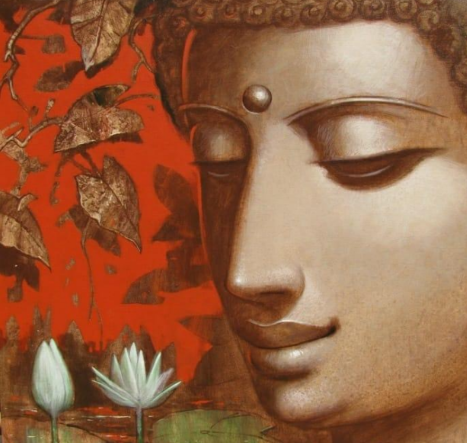
A carefully created hand-painted reproduction may also appeal to collectors who appreciate classical Indian art.
When buying such a work, it is better to describe it accurately as an Ajanta-inspired painting or hand-painted reproduction of an Ajanta mural rather than calling a newly produced canvas an original or authentic Ajanta painting. Our guide to art prints or paintings explains how to tell the difference.
Buyers can ask who created the artwork, which mural inspired it, whether it was painted by hand or printed, and what materials were used.
Transparency about the artwork’s origin and process is more useful than relying on vague claims of authenticity. Our tips on buying original paintings cover the key questions to ask before any purchase.
Preserving the Legacy of Ajanta
Ajanta is not important simply because the paintings are old.
The site represents a remarkable intersection of architecture, sculpture, painting, religion, literature, storytelling, and craftsmanship.
Its artists transformed stone interiors into complex visual environments filled with spiritual ideas and human emotion.
Preserving Ajanta means protecting the physical murals, but it also means continuing to study and understand the knowledge contained within them.
Better documentation, responsible tourism, conservation science, academic research, and public education all contribute to that process.
The more accurately the paintings are studied and presented, the easier it becomes for future generations to appreciate their true significance.
Why Ajanta Still Inspires Us Today
Ajanta paintings remain one of the greatest achievements of ancient Indian art.
Created across different historical periods within a Buddhist monastic complex in Maharashtra, the murals combine religious teaching with extraordinary artistic sophistication.
Their flowing lines, expressive figures, subtle modelling, natural pigments, narrative compositions, elegant Bodhisattvas, Jataka stories, palace scenes, animals, jewellery, and architectural details reveal the skill and imagination of the artists who created them.
Works such as Bodhisattva Padmapani continue to attract attention because they communicate emotion and spiritual depth even after many centuries.
At the same time, Ajanta is much larger than any single famous image.
Its caves preserve evidence of Buddhist belief, artistic innovation, social life, long-distance cultural exchange, and changing patterns of patronage.
For anyone interested in Indian paintings, Buddhist art, ancient history, or traditional craftsmanship, Ajanta offers an extraordinary window into India’s artistic heritage.
At The Brush Strokes Co., you can explore original paintings and Indian art collections inspired by India’s rich artistic traditions, or contact our team for help choosing a piece for your home.
FAQ
What are Ajanta paintings?
Ajanta paintings are ancient Buddhist murals found on the walls and ceilings of the Ajanta Caves in Maharashtra, India. They depict the Buddha, Bodhisattvas, Jataka tales, royal scenes, animals, and aspects of everyday life.
Where are the Ajanta paintings located?
The paintings are located inside the Ajanta Caves in Maharashtra, near Chhatrapati Sambhajinagar, formerly known as Aurangabad.
When were Ajanta paintings made?
The Ajanta Caves developed in more than one phase. Early activity dates to approximately the second to first centuries BCE, while the major later phase flourished mainly during the fifth century CE.
Who created the Ajanta paintings?
The names of most individual artists are unknown. The paintings were produced by skilled artists and craftsmen working within Buddhist religious environments supported by rulers, nobles, monks, and other patrons.
What are the main features of Ajanta paintings?
Major features include graceful lines, expressive faces, subtle shading, elegant human figures, narrative compositions, naturalistic animals, elaborate jewellery, decorative textiles, and sophisticated representations of emotion.
Which technique was used in Ajanta paintings?
The paintings were executed on carefully prepared plastered wall surfaces. Pigments were generally applied to a relatively dry prepared surface using techniques often described as tempera or secco-like rather than true wet fresco.
What colours were used in Ajanta paintings?
Ajanta painters used natural pigments including red and yellow ochres, green earth, black, white or pale mineral materials, and selected blue pigments such as ultramarine derived from lapis lazuli.
What stories are shown in Ajanta paintings?
Many paintings depict Jataka tales describing previous lives of the Buddha. Other murals portray scenes from the Buddha’s life, Bodhisattvas, royal courts, processions, animals, and everyday social life.
What are Jataka tales?
Jataka tales are Buddhist stories describing earlier births of the Buddha. They often teach values such as compassion, generosity, wisdom, self-sacrifice, and patience.
Which is the most famous Ajanta painting?
The painting of Bodhisattva Padmapani in Cave 1 is generally considered one of the most famous and recognisable paintings at Ajanta.
Where is the Padmapani painting located?
The famous Bodhisattva Padmapani mural is located in Cave 1 of the Ajanta complex.
Which Ajanta caves contain important paintings?
Caves 1, 2, 9, 10, 16, and 17 are particularly important for surviving mural paintings, although painted remains exist elsewhere in the complex.
Are there 29 or 30 Ajanta Caves?
UNESCO describes the Ajanta complex as containing 30 caves when unfinished caves are included. Some older and popular sources refer to 29 numbered caves, which is why both numbers are frequently encountered.
Who rediscovered the Ajanta Caves?
British cavalry officer John Smith encountered the caves during a hunting expedition in 1819, after which the site attracted increasing archaeological and scholarly attention.
Why are Ajanta paintings important?
Ajanta paintings are important because they preserve outstanding examples of ancient Indian mural art and provide valuable information about Buddhism, storytelling, artistic techniques, clothing, jewellery, architecture, court culture, and society.
Are Ajanta paintings frescoes?
They are often casually called frescoes, but the technique differs from traditional wet-plaster buon fresco. The pigments were applied to carefully prepared surfaces using a method generally described as tempera or secco-like painting.
What is special about Ajanta Cave 1?
Cave 1 contains some of the site’s most famous later paintings, including Bodhisattva Padmapani and Vajrapani, along with richly detailed Buddhist narrative scenes.
What is the difference between Ajanta and Ellora?
Ajanta is especially famous for its Buddhist mural paintings and Buddhist caves. Ellora contains Buddhist, Hindu, and Jain monuments and is particularly renowned for its rock-cut architecture and sculpture, including the Kailasa Temple.